Today's
EarthStation1.com 15% Off Commemorative Memorial Title: Those
Oldies But Goodies Rock & Roll Doo-Wop MP3 Set DVD Download
USB
Today, April 28, 2026
April 28: Kiss Your Mate Day: -- A day
that is strictly classified with lip contact. Have you been so
romantically lost while kissing, that you accidentally bit your
partner's lips? Feel no remorse as that tells how romantically
connected you are to them. Kissing is known around the world, for
it is found among people of all colors, ages, and religions. And
different kissing styles abound for lovers' experimentation. If
you love kissing your partner, you will love this day. How about a
day full of kisses? While it is quite difficult to confirm the
inventor and where this holiday draws its inspiration from, its
purpose is very clear - to be all kissy with one's partner. The
earliest indication of celebration of this holiday dates back to a
few years back - approximately less than five years ago. Its
recent beginning notwithstanding, people are happy the day is
around as it provides an opportunity for lovers, couples, and even
friends to smooch one another, and for those far away from their
partners, to send special romantic kiss quotes and messages.
Kissing is one of the most romantic and non-verbal ways of
demonstrating love to one's partner. Although it is said to be a
recent development in Western cultures, it has been around for a
few thousand years back in Asia. The origin of kissing is traced
back to the Vedic scriptures of Hinduism and Buddhism. The "Kama
Sutra" - a manual book on sexuality and erotism - mentioned
it. The kissing tradition did not get to Europe until the time of
Alexander the Great - when he conquered parts of Punjab in
northern India. It will interest you to know that kissing - just
like eating and drinking -need not be taught. The ability to kiss
is inherent in every human and one only needs to be in a situation
that warrants doing it. However, as all things are inherent, one
may learn to kiss better. This probably might have led to the
innovation of different kissing styles, popular among lovers being
the 'French kiss.' Many people now engage in the kissing habit.
Virtually everyone that has once been in an amorous relationship
with someone has kissed before. In the United States, kissing is
so common among teenagers that one research recorded that over 80%
of teenagers have experienced it. On Sale @ 15% Off Discount Till
Midnight PT!
https://store.earthstation1.com/those-oldies-but-goodies-rock-amp-roll-doo-wop-mp3-dv3.html
Today's
EarthStation1.com 15% Off Commemorative Memorial Title: Lost TV
Pilots 3 Superman, Superpup, Archie, Patty Duke DVD, MP4, USB
Today, April 28, 2026
April 28: National Superhero Day: --
Marvel employees created National Superhero Day on April 28, 1995
to celebrate everyone's favorite superhero. This is for
superheroes only - we all know villains aren't deserving of their
own day. Still, the idea behind superhero day is to honor those
who serve and protect while fighting evil. No matter who your
favorite hero is, honoring the real or fictional people that
inspire us is a worthwhile cause this April 28. Caped crusaders,
masked vigilantes, mutants, guardians, and immortal gods are all
celebrated on National Superhero Day on April 28. For a day that's
all about celebrating superheroes, it's no surprise that National
Superhero Day was founded by Marvel Comics in 1995. Now, every
year since its birth on April 28, 1995, people come together
annually on this day to celebrate all their favorite heroes. No
matter if your chosen heroes are fictional or real, this is the
day to be thankful for them. If you don't know about Marvel
Comics, think about all those superheroes you loved growing up
(and probably still love). We're talking about Spiderman, Thor,
Ironman, Black Widow, Captain Marvel, and many other fan
favorites. Those heroes are all from Marvel comics, the creators
of "The Fantastic Four," "The Avengers," and
"X-Men." However, Marvel superheroes aren't the only
ones out there. If you're a fan of Batman, Wonder Woman, or
Superman, those superheroes were created by DC Comics, and they
are equally celebrated on this day! Did you know the first
superhero ever was created in 1936? He was named Phantom and he
started with his own comic strip in a U.S. newspaper. This was the
first known beginnings of a published superhero and, today, there
are hundreds of well-known heroes that everyone loves. As for
real-life superheroes, National Superhero Day also recognizes
those who we look up to every day. No matter if they wear masks,
capes, scrubs, or uniforms, everyone has someone they think of as
a superhero. This national day began and grew so that everyone's
role models could get a well-deserved shout-out for whatever hard
work they do. Who's your favorite superhero? On Sale @ 15% Off
Discount Till Midnight PT!
https://store.earthstation1.com/lost-tv-pilots-3-superman-superpup-archie-patty-duk3.html
Today's
EarthStation1.com 15% Off Commemorative Memorial Title: A Night At
The Nuyorican Poet's Cafe 102690 DVD, Download, USB Drive
Today, April 28, 2026
April 28: National Great Poetry Reading
Day: -- A day at the end of National Poetry Month that celebrates
distinguished poetry and the notable poets who wrote them. As an
art form, poetry may predate literacy. Epic poetry appears to have
been composed in poetic form to aid memorization and oral
transmission in prehistoric and ancient societies. It is directly
from folk songs that other types of poetry developed. With so many
forms of poetry to choose from, no one is limited. For example,
choose from the sonnet, shi, villanelle, tanka, haiku, ode, and
ghazal. There are also different genres of poetry including
narrative, epic, dramatic, satirical, lyric, elegy, verse fable,
prose, and speculative poetry. Some of the well-known, great poets
include William Shakespeare, Edgar Allan Poe, Henry Wadsworth
Longfellow, Robert Frost, Mark Twain, Emily Dickinson, Maya
Angelou, and T.S. Eliot. To observe Great Poetry Reading Day: Who
is your favorite great poet? Share a verse or two with others;
Introduce the great poets to someone you know; Settle back, relax,
and read your favorite poetry; Explore the poems of William Blake
or John Keats; If you're unfamiliar with Maya Angelou, discover
her poetry now. Perhaps a few lines of E.E. Cummings or Elizabeth
Barrett Browning will complete the day. Who else? Silvia Plath?
Oscar Wilde? William Carlos Williams? Host a small poetry reading
in your living room. Pick your favorite poems and read them aloud;
Attend a poetry slam; Explore the poetry section at the library;
Share your poetry with others or start a poetry group; Discover
local poets and grow your library; and use #GreatPoetryReadingDay
to post on social media! On Sale @ 15% Off Discount Till Midnight
PT!
https://store.earthstation1.com/a-night-at-the-nuyorican-poet39s-cafe-102690-dvd-download-u39102690.html
Today's
EarthStation1.com 15% Off Commemorative Memorial Title: Soldiers:
A History Of Men In Battle TV Series + Bonus Title DVD MP4
Today, April 28, 2026
April 28, 1503: The Italian Wars: The
Italian Wars Of 1499-1504: The Third Italian War (1502-1504)(The
War Over Naples): The Battle Of Cerignola: -- One of the first
European battles in history won by small arms fire using gunpowder
is fought between Spanish and French armies outside the town of
Cerignola, Apulia, Kingdom of Naples. Spanish forces under Gonzalo
Fernandez de Cordoba, 6,300 men including 2,000 landsknechte
(Germanic mercenaries used in pike and shot formations until the
development of the bayonet in the late 17th century) with more
than 1,000 arquebusiers (a form of long gun) and 20 cannons,
defeated the French who had 9,000 men, mainly heavy gendarme
cavalry and Swiss mercenary pikemen, with about 40 cannons, and
led by Louis d'Armagnac, Duke of Nemours, who was killed in the
battle. As it was one of the first European battles fought and won
by gunpowder weapons, the assault by Swiss pikemen and French
cavalry was shattered by the fire of Spanish arquebusiers behind a
ditch. On Sale @ 15% Off Discount Till Midnight PT!
https://store.earthstation1.com/soldiers-a-history-of-men-in-battle-4-dvds-all-13-sh413.html
Today's
EarthStation1.com 15% Off Commemorative Memorial Title: Portraits
Of American Presidents Nos. 1-42 TV Series MP4 Download DVD
Today, April 28, 2026
April 28, 1758: #BOTD: #HBD! James
Monroe, American soldier, statesman, Founding Father lawyer, and
politician, 5th President of the United States from 1817 to 1825
(d. July 4, 1831) is #born in Westmoreland County, Virginia.
Monroe was the last president of the Virginia dynasty, and his
presidency ushered in what is known as the Era of Good Feelings.
Born in Westmoreland County, Virginia, Monroe was of the planter
class and fought in the American Revolutionary War. He was wounded
in the Battle of Trenton with a musket ball to his shoulder. After
studying law under Thomas Jefferson from 1780 to 1783, he served
as a delegate in the Continental Congress. As an anti-federalist
delegate to the Virginia convention that considered ratification
of the United States Constitution, Monroe opposed ratification,
claiming it gave too much power to the central government. He took
an active part in the new government, and in 1790 he was elected
to the Senate of the first United States Congress, where he joined
the Democratic-Republicans. He gained experience as an executive
as the Governor of Virginia and rose to national prominence as a
diplomat in France, when he helped negotiate the Louisiana
Purchase in 1803. During the War Of 1812, Monroe served in
critical roles as Secretary Of State and the Secretary of War
under President James Madison. Facing little opposition from the
fractured Federalist Party, Monroe was easily elected president in
1816, winning over 80 percent of the electoral vote and becoming
the last president during the First Party System era of American
politics (a model of American politics used in history and
political science to periodize the political party system that
existed in the United States between roughly 1792 and 1824). As
president, he sought to ease partisan tensions, embarking on a
tour of the country that was well received. With the ratification
of the Treaty of 1818, under the successful diplomacy of his
Secretary Of State John Quincy Adams, the United States extended
its reach from the Atlantic to the Pacific, by acquiring harbor
and fishing rights in the Pacific Northwest; the United States and
Britain jointly occupied the Oregon Country. In addition to the
acquisition of Florida, the 1819 Adams-Onis Treaty secured the
westernmost section of the southern border of the United States
along the 42nd Parallel to the Pacific Ocean and represented
America's first determined attempt at creating an "American
global empire". As nationalism surged, partisan acrimony
subsided. This swell of national purpose and political harmony
subsided some when the Panic of 1819 struck and a dispute over the
admission of Missouri embroiled the country in 1820. Nonetheless,
Monroe won near-unanimous reelection. Monroe supported the
founding of colonies in Africa for freed slaves that would
eventually form the nation of Liberia, whose capital, Monrovia, is
named in his honor. In 1823, he announced the United States'
opposition to any European intervention in the recently
independent countries of the Americas with the Monroe Doctrine,
which became a landmark in American foreign policy. His presidency
concluded the first period of American presidential history before
the beginning of Jacksonian democracy and the Second Party System
era. Following his retirement in 1825, Monroe was plagued by
financial difficulties. James Monroe died in New York City on the
anniversary of 1) the Declaration Of Independence, 2) the death of
fellow founding father Thomas Jefferson, and 3) the death of
fellow founding father John Adams. He was buried in Marble
Cemetery in New York City, then moved to The James Monroe Tomb in
Hollywood Cemetery, Richmond, Virginia. The principal feature of
the tomb is an architecturally unusual cast iron cage, designed by
Albert Lybrock and installed in 1859. The tomb was declared a
National Historic Landmark in 1971 for its unique architecture. To
Richmonders it is colloquially known as The Birdcage. He has been
generally ranked as an above-average president. On Sale @ 15% Off
Discount Till Midnight PT!
https://store.earthstation1.com/portraits-of-american-presidents-nos-142-tv-series-mp4-download1424.html
Today's
EarthStation1.com 15% Off Commemorative Memorial Title: Damn The
Defiant! H.M.S. Defiant 1962 RN Alec Guinness DVD MP4 USB
Today, April 28, 2026
April 28, 1789: Naval History: The
History Of The Royal Navy: The Voyage Of Bounty (The Voyage Of The
HMS Bounty): Mutinies: Royal Navy Mutinies: Piracy: Acts Of
Piracy: The Mutiny On The Bounty (The Mutiny Of The HMS Bounty): -
The mutiny on the Royal Navy vessel HMS Bounty occurs when
disaffected crewmen, led by acting-Lieutenant Fletcher Christian,
seize control of the ship after a three-week string of paranoid
schizophrenic, erratic and illogical behavior, largely inflicted
upon Christian. Bounty had left England in 1787 on a mission to
collect and transport breadfruit plants from Tahiti to the West
Indies. A five-month layover in Tahiti, during which many of the
men lived ashore and formed relationships with native Polynesians,
led those men to be less amenable to naval discipline. Relations
between Bligh and his crew deteriorated after he reportedly began
handing out increasingly harsh punishments, criticism, and abuse,
with Christian being a particular target. After three weeks back
at sea, Christian and others forced Bligh from the ship.
Twenty-five men remained on board afterwards, including loyalists
held against their will, and others for whom there was no room in
the launch. On June 14, 1789, after an historic voyage of
unparalleled seamanship and navigation of nearly 4,600 miles
(7,400 km) journey in an open boat, having been cast adrift some
30 nautical miles (35 miles, 56 km) south of the Tonga island of
Tofua in the South Pacific Ocean by the mutineers, the survivors
of Captain Bligh's Launch Voyage From The HMS Bounty, including
Lieutenant William Bligh and 18 of the loyal crewmen who went with
him, reached the Dutch settlement of Coupang (modern Kupang, the
capital of the Indonesian province of East Nusa Tenggara) on the
island of Timor, an island at the southern end of Maritime
Southeast Asia, in the north of the Timor Sea, an island that has
since been divided between Indonesia and East Timor. Bligh hoped
to find water and food on Tofua, then proceed to the nearby island
of Tongatapu to seek help from King Poulaho (whom he knew from his
visit with Cook) in provisioning the boat for a voyage to the
Dutch East Indies. Ashore at Tofua, there were encounters with
natives who were initially friendly but grew more menacing as time
passed. On May 2, four days after landing, Bligh realised that an
attack was imminent. He directed his men back to the sea, shortly
before the Tofuans seized the launch's stern rope and attempted to
drag it ashore. Bligh coolly shepherded the last of his shore
party and their supplies into the boat. In an attempt to free the
rope from its captors, the quartermaster John Norton leapt into
the water; he was immediately set upon and stoned to death. The
launch escaped to the open sea, where the shaken crew reconsidered
their options. A visit to Tongatapu, or any island landfall, might
incur similarly violent consequences; their best chance of
salvation, Bligh reckoned, lay in sailing directly to the Dutch
settlement of Kupang in Timor, using the rations presently on
board. This was a journey of some 3,500 nautical miles (6,500 km;
4,000 mi) to the west, beyond the Endeavour Strait, and it would
necessitate daily rations of an ounce of bread and a quarter-pint
of water for each man. The plan was unanimously agreed. From the
outset, the weather was wet and stormy, with mountainous seas that
constantly threatened to overwhelm the boat. When the sun
appeared, Bligh noted in his daily journal that it "gave us
as much pleasure as a winter's day in England". Bligh
endeavoured to continue his journal throughout the voyage,
observing, sketching, and charting as they made their way west. To
keep up morale, he told stories of his prior experiences at sea,
got the men singing, and occasionally said prayers. The launch
made the first passage by Europeans through the Fiji Islands, but
they dared not stop because of the islanders' reputation for
cannibalism. On May 17, Bligh recorded that "our situation
was miserable; always wet, and suffering extreme cold ... without
the least shelter from the weather". A week later with the
skies clearing, birds began to appear, signalling a proximity to
land. On May 28, the Great Barrier Reef was sighted; Bligh found a
navigable gap and sailed the launch into a calm lagoon. Late that
afternoon, he ran the boat ashore on a small island off the coast
of northeast Australia, which he named Restoration Island. Here,
the men found oysters and berries in plentiful supply and were
able to eat ravenously. Over the next four days, the party
island-hopped northward within the lagoon, aware that their
movements were being closely monitored by natives on the mainland.
Strains were showing within the party; following a heated
disagreement with Purcell, Bligh grabbed a cutlass and challenged
the carpenter to fight. Fryer told Cole to arrest their captain
but backed down after Bligh threatened to kill him if he
interfered. On June 2, the launch cleared Cape York, the extreme
northern point of the Australian continent. Bligh turned
south-west and steered through a maze of shoals, reefs, sandbanks,
and small islands. The route taken was not the Endeavour Strait,
but a narrower southerly passage later known as the Prince of
Wales Channel. At 20:00 that evening they reached the open Arafura
Sea, still 1,100 nautical miles (2,000 km; 1,300 mi) from Kupang.
The following eight days encompassed some of the toughest travel
of the entire journey and, by June 11, many were close to
collapse. The next day, the coast of Timor was sighted: "It
is not possible for me to describe the pleasure which the blessing
of the sight of this land diffused among us", Bligh wrote. On
June 14, with a makeshift Union Jack hoisted, they sailed into
Kupang harbour. In Kupang, Bligh reported the mutiny to the
authorities, and wrote to his wife: "Know then, my own Dear
Betsey, I have lost the Bounty ..." Nelson the botanist
quickly succumbed to the harsh Kupang climate and died. On August
20, the party departed for Batavia (now called Jakarta) to await a
ship for Europe; the cook Thomas Hall died there, having been ill
for weeks. Bligh obtained passages home for himself, his clerk
Samuel, and his servant John Smith, and sailed on October 16,
1789. Four of the remainder -- the master's mate Elphinstone, the
quartermaster Peter Linkletter, the butcher Robert Lamb and the
assistant surgeon Thomas Ledward -- all died either in Batavia or
on their journeys home. Fifteen years after the Bounty mutiny, he
was appointed Governor Of New South Wales in Australia, with
orders to clean up the corrupt rum trade of the New South Wales
Corps. His actions directed against the trade resulted in the
so-called Rum Rebellion, during which Bligh was again placed under
arrest and deposed from his command. On Sale @ 15% Off Discount
Till Midnight PT!
https://store.earthstation1.com/damn-the-defiant-alec-guinness-napoleonic-british-naval-dvd.html
Today's
EarthStation1.com 15% Off Commemorative Memorial Title: Napoleon
(1955) Raymond Pellagrin Orson Welles DVD, Download, USB
Today, April 28, 2026
April 28, 1792: The Age Of Enlightenment
(The Enlightenment, The Age Of Reason): The Age Of Revolution: The
Atlantic Revolutions: The French Revolution: The French
Revolutionary And Napoleonic Wars (The Great French War) (The
French Revolutionary Wars, The Napoleonic Wars): -- The French
Revolutionary Wars (1792-1802) begin as France invades the
Austrian Netherlands (present day Belgium and Luxembourg). As
early as 1791, the other monarchies of Europe looked with outrage
at the revolution and its upheavals; and they considered whether
they should intervene, either in support of King Louis XVI, to
prevent the spread of revolution, or to take advantage of the
chaos in France. The key figure in initial foreign reaction to the
revolution was Holy Roman Emperor Leopold II, brother of Louis
XVI's Queen Marie Antoinette. Leopold had initially looked on the
Revolution with equanimity, but became more and more disturbed as
the Revolution became more radical, although he still hoped to
avoid war. On August 27 1791, Leopold and King Frederick William
II of Prussia, in consultation with emigrant French nobles, issued
the Declaration of Pillnitz, which declared the interest of the
monarchs of Europe in the well-being of Louis and his family, and
threatened vague but severe consequences if anything should befall
them. Although Leopold saw the Pillnitz Declaration as a
non-committal gesture to placate the sentiments of French
monarchists and nobles, it was seen in France as a serious threat
and was denounced by the revolutionary leaders. France eventually
issued an ultimatum demanding that the Habsburg Monarchy of
Austria under Leopold II, who also was Emperor of the Holy Roman
Empire, renounce any hostile alliances and withdraw its troops
from the French border. The reply was evasive, and the Assembly
voted for war on April 20, 1792 against Francis II (who succeeded
Leopold II), after a long list of grievances presented by foreign
minister Charles Francois Dumouriez. Dumouriez prepared an
immediate invasion of the Austrian Netherlands, where he expected
the local population to rise against Austrian rule as they had
earlier in 1790. However, the revolution had thoroughly
disorganized the army, and the forces raised were insufficient for
the invasion. Following the declaration of war, French soldiers
deserted en masse and in one case murdered their general, Theobald
Dillon. While the revolutionary government frantically raised
fresh troops and reorganized its armies, a mostly Prussian Allied
army under Charles William Ferdinand, Duke of Brunswick assembled
at Koblenz on the Rhine. The duke then issued a proclamation
called the Brunswick Manifesto (July 1792), written by the French
king's cousin, Louis Joseph de Bourbon, Prince de Conde, the
leader of an emigre corps within the Allied army, which declared
the Allies' intent to restore the king to his full powers and to
treat any person or town who opposed them as rebels to be
condemned to death by martial law. This, however, had the effect
of strengthening the resolve of the revolutionary army and
government to oppose them by any means necessary. By August 10
1792, a crowd stormed the Tuileries Palace, seizing the king and
his family, resulting in the August 19 invasion by Brunswick's
army. The French Revolutionary Wars were a series of sweeping
military conflicts lasting from 1792 until 1802 and resulting from
the French Revolution. They pitted France against Great Britain,
Austria, Prussia, Russia and several other monarchies. They are
divided in two periods: the War of the First Coalition (1792-97)
and the War of the Second Coalition (1798-1802). Initially
confined to Europe, the fighting gradually assumed a global
dimension. After a decade of constant warfare and aggressive
diplomacy, France had conquered a wide array of territories, from
the Italian Peninsula and the Low Countries in Europe to the
Louisiana Territory in North America. French success in these
conflicts ensured the spread of revolutionary principles over much
of Europe, but at a terrible cost in lives, property and treasure
to all involved. On Sale @ 15% Off Discount Till Midnight PT!
https://store.earthstation1.com/napoleon-1955-dvd-raymond-pellagrin-orson-welles-2-19552.html
Today's
EarthStation1.com 15% Off Commemorative Memorial Title: The Big
Four: Tycoons Of The First Transcontinental Railroad MP4 DVD
Today, April 28, 2026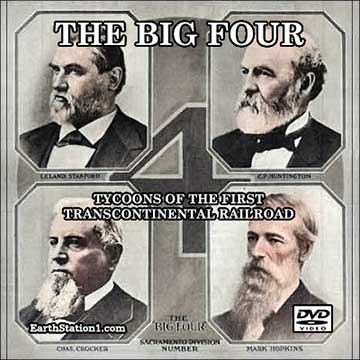
April 28, 1869: The History Of Rail Transport (The History Of Railways): The History Of Rail Transportation In The United States: The First Transcontinental Railroad (The Pacific Railroad, The Overland Route): -- Chinese and Irish laborers for the Central Pacific Railroad working on the First Transcontinental Railroad lay ten miles of track in one day, a feat which has never been matched. The First Transcontinental Railroad (also called the Great Transcontinental Railroad, known originally as the "Pacific Railroad" and later as the "Overland Route") was a 1,912-mile continuous railroad line constructed between 1863 and 1869 that connected the existing eastern U.S. rail network at Omaha, Nebraska/Council Bluffs, Iowa with the Pacific coast at the Oakland Long Wharf on San Francisco Bay. The rail line was built by three private companies over public lands provided by extensive US land grants. Construction was financed by both state and US government subsidy bonds as well as by company issued mortgage bonds. The coast-to-coast railroad connection revolutionized the settlement and economy of the American West. It brought the western states and territories into alignment with the northern Union states and made transporting passengers and goods coast-to-coast considerably quicker and less expensive. On Sale @ 15% Off Discount Till Midnight PT! https://store.earthstation1.com/bigfotyoffit.html
Today's
EarthStation1.com 15% Off Commemorative Memorial Title: To Be
Hamlet TV Documentary Series DVD, Video Download, USB Drive
Today, April 28, 2026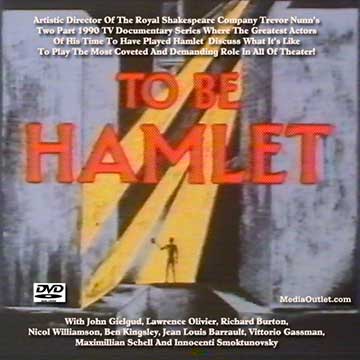
April 28, 1878: #BOTD: #HBD! Lionel
Barrymore, American actor of stage, screen and radio as well as a
film director (d. November 15, 1954) is #born Lionel Herbert
Blythe in Philadelphia, Pennsylvania. John Barrymore won an
Academy Award for Best Actor for his performance in A Free Soul
(1931), and remains best known to modern audiences for the role of
the villainous Mr. Potter character in Frank Capra's 1946 film
It's a Wonderful Life. He is also particularly remembered as
Ebenezer Scrooge in annual broadcasts of A Christmas Carol during
his last two decades. He is also known for playing Dr. Leonard
Gillespie in MGM's nine Dr. Kildare films, a role he reprised in a
further six films focussing solely on Gillespie and in a radio
series entitled The Story of Dr. Kildare. He was a member of the
theatrical Barrymore family. Lionel Barrymore died from a heart
attack in the Van Nuys neighborhood of Los Angeles, aged 76. He is
entombed in Calvary Cemetery in East Los Angeles, California.
Barrymore received two stars on the Hollywood Walk of Fame in 1960
- a motion pictures star and a radio star. The stars are located
at 1724 Vine Street for motion pictures, and 1651 Vine Street for
radio. He was also inducted into the American Theater Hall of
Fame, along with his siblings, Ethel and John. On Sale @ 15% Off
Discount Till Midnight PT!
https://store.earthstation1.com/to-be-hamlet-dvd-2-part-1990-tv-documentary-s21990.html
Today's
EarthStation1.com 15% Off Commemorative Memorial Title: Machito: A
Latin Jazz Legacy DVD, MP4 Video Download, USB Flash Drive
Today, April 28, 2026
April 28, 1911: #BOTD: #HBD! Mario Bauza,
Afro-Cuban composer, bandleader clarinetist, saxophonist and
trumpeter, pioneer of both Latin jazz and Afro-Cuban jazz whose
composition "Tanga", performed by Machito And The
Afro-Cubans, was the first first true Latin jazz tune generally,
first Afro-Cuban jazz tune particularly, and the first piece to
blend jazz with clave, the primary rhythmic pattern used in Cuban
music (d. July 11, 1993) is #born Prudencio Mario Bauza Cardenas
in Havana, Cuba. He was among the first to introduce Cuban music
to the United States by bringing Cuban musical styles to the New
York City jazz scene. While Cuban bands had had popular jazz tunes
in their repertoire for years with limited success, Bauza's 1943
composition "Tanga" (meaning a particular revealing
style of thong) was a major hit, and the first composition to
explore modal harmony (a concept explored later by Miles Davis and
Gil Evans) from a jazz arranging perspective. Initially a descarga
(Cuban Jam) in mambo tempo with jazz soloists, spontaneously
composed by Bauza. "Tanga", which was over time arranged
with a more formal arrangement. Of note is the sheet of sound
effect in the arrangement through the use of multiple layering.
Under Bauza's direction, Machito and his Afro-Cubans were first
band to successfully wed jazz big band arranging techniques within
an original composition with jazz oriented soloists utilizing an
authentic Afro-Cuban-based rhythm section in a successful manner,
e.g. Gene Johnson - alto, Brew Moore - tenor, composition. Mario
Bauza died of cancer at his home in Manhattan, New York City, aged
82. His burial details are unknown. On Sale @ 15% Off Discount
Till Midnight PT!
https://store.earthstation1.com/machito-a-latin-jazz-legacy-dvd.html
Today's
EarthStation1.com 15% Off Commemorative Memorial Title: Saddam
Hussein: His Life, His Regime, His Iraq DVD, Download, USB
Today, April 28, 2026
April 28, 1937: #BOTD: Saddam Hussein,
Iraqi general and politician, 5th President of Iraq from July 16,
1979 to April 9, 2003 (d. December 30, 2006) is #born Saddam
Hussein Abd al-Majid al-Tikriti in Al-Awja, Saladin Governorate,
Kingdom of Iraq. He was a leading member of the revolutionary Arab
Socialist Ba'ath Party, and later, the Baghdad-based Ba'ath Party
and its regional organization the Iraqi Ba'ath Party. The Iraqi
Ba'ath Party espoused Ba'athism, an Arab nationalist ideology that
promotes the development and creation of a unified Arab state
through the combination of of a Marxist-Leninist vanguard party
leadership and a progressive revolutionary government. Saddam
played a key role in the 1968 coup (later referred to as the 17
July Revolution), a bloodless coup led by General Ahmed Hassan
al-Bakr which brought the Iraqi Ba'ath Party to power. As vice
president under the ailing General Ahmed Hassan al-Bakr, and at a
time when many groups were considered capable of overthrowing the
government, Saddam created security forces through which he
tightly controlled conflicts between the government and the armed
forces. In the early 1970s, Saddam nationalized oil and foreign
banks, a decision that ultimately resulted in the country;s
insolvency caused by Iran-Iraq War, the Gulf War, and UN
sanctions. Through the 1970s, Saddam cemented his authority over
the apparatus of government as oil money helped Iraq's economy to
grow at a rapid pace. Positions of power in the country were
mostly filled with Sunni Arabs, a minority that made up only a
fifth of the population. Saddam formally rose to power in 1979,
although he had already been the de facto head of Iraq for several
years. He suppressed several movements, particularly Shi'a and
Kurdish movements, which sought to overthrow the government or
gain independence, and maintained power during the Iran-Iraq War
and the Gulf War. Whereas some in the Arab world lauded Saddam for
opposing the United States and attacking Israel, he was widely
condemned for the brutality of his dictatorship. The total number
of Iraqis killed by the security services of Saddam's government
in various purges and genocides is conservatively estimated to be
250,000. Saddam's invasions of Iran and Kuwait also resulted in
hundreds of thousands of deaths. He acquired the title "Butcher
of Baghdad". In 2003, a coalition led by the U.S. invaded
Iraq to depose Saddam, in which U.S. President George W. Bush and
British Prime Minister Tony Blair falsely accused him of
possessing weapons of mass destruction and having ties to
al-Qaeda. Saddam's Ba'ath party was disbanded and elections were
held. Following his capture on 13 December 2003, the trial of
Saddam took place under the Iraqi Interim Government. On November
5, 2006, Saddam was convicted by an Iraqi court of crimes against
humanity related to the 1982 killing of 148 Iraqi Shi'a, and
sentenced to death by hanging. He was executed on December 30,
2006. He was buried in the town of his birth, Al-Awja near Tikrit,
in an octagonal domed building that he had commissioned in the 80s
inside a family plot where his family members including his sons
Uday and Qusay were buried. However the tomb was destroyed in the
fight between ISIS and the Iraqi State military forces. There is
some debate about whether Saddam's body was exhumed before the
strikes and taken away elsewhere or it was destroyed along with
the tomb. There is no way to confirm this given the chaos that had
ensued both before and after the battles. On Sale @ 15% Off
Discount Till Midnight PT!
https://store.earthstation1.com/saddam-hussein-his-life--his-regime--his-iraq-dvd-3-disc3.html
Today's
EarthStation1.com 15% Off Commemorative Memorial Title: Elvis
Presley Documentaries Set MP4 Video Download DVD
Today, April 28, 2026
April 28, 1941: #BOTD: #HBD! Ann-Margret,
Swedish-American actress, singer, dancer, sex symbol, cultural
icon and beauty, is #born Ann-Margret Olsson in Valsjobyn,
Jamtland County, Sweden. Known mononymously as Ann-Margret, she is
best known as an actress for her roles in Bye Bye Birdie (1963),
Viva Las Vegas (1964), The Cincinnati Kid (1965), Carnal Knowledge
(1971), The Train Robbers (1973), Tommy (1975), Grumpy Old Men
(1993), Grumpier Old Men (1995), and All's Faire in Love (2009).
She has won five Golden Globe Awards and been nominated for two
Academy Awards, two Grammy Awards, a Screen Actors Guild Award,
and six Emmy Awards. In 2010, she won an Emmy Award for her guest
appearance on Law & Order: Special Victims Unit. Her singing
and acting careers span five decades, starting in 1961; initially,
she was billed as a female version of Elvis Presley. She has a
sultry, vibrant contralto voice. She had a minor hit in 1961, "I
Just Don't Understand", a song written by Marijohn Wilkin and
Kent Westberry, that charted at No. 17 on the US Billboard Hot 100
chart. She charted with an album in 1964, and scored a disco hit
in 1979. She recorded a critically acclaimed gospel album in 2001,
and an album of Christmas songs in 2004. On Sale @ 15% Off
Discount Till Midnight PT!
https://store.earthstation1.com/viva-elvis-dvd-elvis-presley-cult-documentary.html
Today's
EarthStation1.com 15% Off Commemorative Memorial Title: Benito
Mussolini Documentaries DVD, MP4 Video Download, USB Drive
Today, April 28, 2026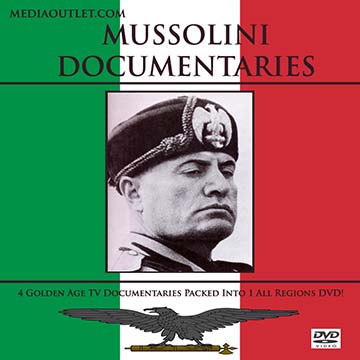
April 28, 1945: The European Civil War:
World War II: The Second European War (The European Theater Of
World War II): The Mediterranean And Middle East Theater Of World
War II (The Mediterranean Theater Of War) The Italian Campaign Of
World War II (The Liberation Of Italy): The Italian Civil War
(Italian: Guerra Civile Italiana): -- #DOTD: Twenty three years of
Fascist rule in Italy abruptly ends as Italian partisans shoot and
kill Benito Mussolini. The day before, Mussolini and his mistress
Clara Petacci were arrested in Dongo, Lombardy by two communist
partisans known by the nom de guerre (war name) they used, Valerio
and Bellini, and Mussolini was identified by the Political
Commissar of the partisans' 52nd Garibaldi Brigade, Urbano
Lazzaro. After several unsuccessful attempts to take them to Como
they were brought to Mezzegra, and they spent their last night in
the house of the De Maria family. The next day, Mussolini and
Petacci both received a summary execution, shot along with most of
the members of their 15-man train, primarily ministers and
officials of the Italian Social Republic. The bodies were then
hung upside down and pelted with stones by jeering crowds in
Milan. He is buried at San Cassiano Cemetery in his hometown of
Predappio, Province of Forli-Cesena, Emilia-Romagna, Italy. Benito
Mussolini, Italian politician and journalist, founder of the
fascist political movement The Italian Fasci of Combat (Fasci
Italiani di Combattimento), leader of the National Fascist Party
(Partito Nazionale Fascista, PNF), Prime Minister from 1922 to
1943; constitutional leader of the Italy until 1925, when he
dropped the pretense of democracy and established a dictatorship
(d. April 28, 1945) is #born in Dovia, Italy. Benito Amilcare
Andrea Mussolini was known as Il Duce ("The Leader") and
was the founder of Italian Fascism. In 1912, Mussolini had been a
leading member of the National Directorate of the Italian
Socialist Party (PSI), but was expelled from the PSI for
advocating military intervention in World War I, in opposition to
the party's stance on neutrality. Mussolini served in the Royal
Italian Army during the war until he was wounded and discharged in
1917. Mussolini denounced the PSI, his views now centering on
nationalism instead of socialism and later founded the fascist
movement which came to oppose egalitarianism and class conflict,
instead advocating revolutionary nationalism transcending class
lines. On March 23, 1919, in Milan, Italy, Benito Mussolini
founded the fascist political movement The Italian Fasci of Combat
(Fasci Italiani di Combattimento); Italian Fascism, also known
simply as Fascism, is the original fascist ideology, developed in
Italy and copied by other countries such as Germany and Austria.
Following the March on Rome in October 1922 (an organized mass
demonstration in October 1922, which resulted in Benito
Mussolini's National Fascist Party (Partito Nazionale Fascista, or
PNF) acceding to power in the Kingdom of Italy), Mussolini became
the youngest Prime Minister in Italian history until the
appointment of Matteo Renzi in February 2014. After removing all
political opposition through his secret police and outlawing labor
strikes, Mussolini and his followers consolidated their power
through a series of laws that transformed the nation into a
one-party dictatorship. Within five years, Mussolini had
established dictatorial authority by both legal and extraordinary
means and aspired to create a totalitarian state. On Sale @ 15%
Off Discount Till Midnight PT!
https://store.earthstation1.com/benito-mussolini-dvd-wwii-documentaries.html
Today's
EarthStation1.com 15% Off Commemorative Memorial Title: The Great
Polynesian Navigators Of The Pacific DVD, MP4, USB Drive
Today, April 28, 2026
April 28, 1947: Great Sailing
Expeditions: Experimental Archaeology: Pre-Columbian Trans-Oceanic
Contact: The Kon-Tiki Expedition: -- Norwegian explorer and writer
Thor Heyerdahl and five crew mates, in an attempt to prove that
pre-historic peoples could have traveled from South America, set
out from Peru on a balsa wood raft, the Kon-Tiki, to prove that
Peruvian natives could have settled Polynesia. That following
August 7, the Kon-Tiki smashed into the reef at Raroia in the
Tuamotu Islands, making a safe and successful landfall after a
101-day, 7,000 kilometres (4,300 mi) journey across the Pacific
Ocean. The raft was named Kon-Tiki after the Inca god Viracocha
(Quechuan language: Wiraqucha, possibly meaning "Fat (or
foam) of the sea"), for whom "Kon-Tiki" was said to
be an old name. Kon-Tiki is also the name of Heyerdahl's book, the
Academy Award-winning 1950 documentary film chronicling his
adventures, and the 2012 dramatized feature film nominated for the
Academy Award for Best Foreign Language Film. Heyerdahl believed
that people from South America could have reached Polynesia during
pre-Columbian times. His aim in mounting the Kon-Tiki expedition
was to show, by using only the materials and technologies
available to those people at the time, that there were no
technical reasons to prevent them from having done so. Although
the expedition carried some modern equipment, such as a radio,
watches, charts, sextant, and metal knives, Heyerdahl argued they
were incidental to the purpose of proving that the raft itself
could make the journey. The Kon-Tiki expedition was funded by
private loans, along with donations of equipment from the United
States Army. Heyerdahl and a small team went to Peru, where, with
the help of dockyard facilities provided by the Peruvian
authorities, they constructed the raft out of balsa logs and other
native materials in an indigenous style as recorded in
illustrations by Spanish conquistadores. Thor Heyerdahl's book
about his experience became a bestseller. It was published in
Norwegian in 1948 as The Kon-Tiki Expedition: By Raft Across the
South Seas, later reprinted as Kon-Tiki: Across the Pacific in a
Raft. It appeared with great success in English in 1950, also in
many other languages. A documentary motion picture about the
expedition, also called Kon-Tiki, was produced from a write-up and
expansion of the crew's filmstrip notes and won an Academy Award
in 1951. It was directed by Heyerdahl and edited by Olle Nordemar.
The voyage was also chronicled in the documentary TV-series The
Kon-Tiki Man: The Life and Adventures of Thor Heyerdahl, directed
by Bengt Jonson. There have been multiple hypotheses on the
ultimate origin and mode of dispersal of the Austronesian peoples.
One of the most widely accepted theories is that modern
Austronesians originated from migrations out of Taiwan between
3000 and 1000 BC. Using relatively advanced maritime innovations
like the catamaran, outrigger boats, and crab claw sails, they
were reputed to have rapidly colonized the islands of both the
Indian and the Pacific oceans, and were considered the first
humans to cross vast distances of water on ocean-going boats.
While Polynesians are known to have definitely originated from a
branch of the Austronesian migrations in Island Melanesia, despite
the popularity of hypotheses like Thor Heyerdahl's that
Polynesians were descendants of "bearded white men" who
sailed on primitive rafts from South America, a genetic study by
Stanford University published in the journal Nature on July 8,
2020 concluded that about 800 years ago, Polynesians from the
South Pacific and Native Americans from what is now Colombia
hooked up, creating a genetic signature that still exists in some
Polynesians today. A 2014 study of 27 modern people from Rapa Nui
(Easter Island) found they had Native American ancestry dating
back to between 1300 C.E. and 1500 C.E., at least 200 years before
the first Europeans landed there in 1722 C.E. Other pieces of
evidence have suggested there was pre-Columbian contact between
people in Polynesia and South America. Previous genetic studies of
sweet potatoes suggest the plant was domesticated in Peru and then
spread across Polynesia around 1,000 years ago. And the Polynesian
name for the root vegetable, "kuumala", resembles its
names in the Andean Quechua language: "kumara" and
"cumal." While the genetic record substantiates a common
ancestry, it is nonetheless most likely that it was the
long-established seafaring culture of the Polynesians that
initiated the contact between them and Native Americans - which
means that though Thor Heyerdahl was right that a vessel could
cross the Pacific between South America and Polynesia, contact
would most likely have been made from Polynesia to South America,
and not as Heyerdahl thought the other way round. The original
Kon-Tiki raft is now on display in the Kon-Tiki Museum at Bygdoy
in Oslo. On Sale @ 15% Off Discount Till Midnight PT!
https://store.earthstation1.com/the-great-polynesian-navigators-of-the-pacific-dvd-mp3-us3.html
Today's
EarthStation1.com 15% Off Commemorative Memorial Title: Grand
Admiral Isoroku Yamamoto DVD, MP4 Video Download, USB Drive
Today, April 28, 2026
April 28, 1952: The Aftermath Of World
War II: The Aftermath Of The Pacific War: The Treaty of San
Francisco (Japanese: San-Furanshisuko Kowa-Joyaku) (The Treaty Of
Peace With Japan [Japanese: Nihon-Koku To No Heiwa-Joyaku], The
Peace Treaty Of San Francisco [Japanese: Sanfuranshisuko
Heiwa-Joyaku]): -- The Treaty Of San Francisco, which had been
officially signed and ratified by 48 nations on September 8, 1951,
comes into force, ending the US occupation of Japan, restoring
Japanese sovereignty, and ending its state of war with most of the
Allies of World War II. According to Article 11 of the Treaty,
Japan accepts the judgments of the International Military Tribunal
for the Far East and of other Allied War Crimes Courts imposed on
Japan both within and outside Japan. This treaty served to
officially end Japan's position as an imperial power, to allocate
compensation to Allied civilians and former prisoners of war who
had suffered Japanese war crimes during World War II, and to end
the Allied post-war occupation of Japan and return sovereignty to
that nation. This treaty made extensive use of the United Nations
Charter and the Universal Declaration of Human Rights to enunciate
the Allies' goals. This treaty, along with the Security Treaty
Between the United States and Japan signed that same day, is said
to mark the beginning of the San Francisco System; this term,
coined by historian John W. Dower, signifies the effects of
Japan's relationship with the United States and its role in the
international arena as determined by these two treaties and is
used to discuss the ways in which these effects have governed
Japan's post-war history. This treaty also introduced the problem
of the legal status of Taiwan due to its lack of specificity as to
what country Taiwan was to be surrendered, and hence some
supporters of Taiwan independence argue that sovereignty of Taiwan
is still undetermined. On Sale @ 15% Off Discount Till Midnight
PT!
https://store.earthstation1.com/yamamoto-dvd-grand-admiral-isoroku.html
Today's
EarthStation1.com 15% Off Commemorative Memorial Title: Muhammad
Ali Documentaries And Entire Fights DVD, Download, USB Drive
Today, April 28, 2026
April 28, 1967: The History Of Sports:
The History Of Sports In The United States: The History Of Boxing:
The History Of Heavyweight Boxing: The Aftermath Of World War II:
The Cold War: The Cold War In Asia: The Indochina Wars: The
Vietnam War (The Second Indochina War, The Vietnam Conflict, The
Resistance War Against America): Opposition To United States
Involvement In The Vietnam War: Clay v. United States: -- Boxer
Muhammad Ali appears in Houston for his scheduled induction into
the U.S. Armed Forces, but he refused three times to step forward
when his name was called, thereby refusing induction into the U.S.
Army. An officer warned him that he was committing a felony
punishable by five years in prison and a fine of 10K USD. Once
more, Ali refused to budge when his name was called, and he was
arrested. Later that same day, the New York State Athletic
Commission suspended his boxing license and stripped him of his
title. Other boxing commissions followed suit, and Ali's boxing
license was revoked in every state. Ali would not be able to
obtain a license to box in any state for over three years. At the
trial on June 20, 1967, the jury found Ali guilty after only 21
minutes of deliberation. After a Court of Appeals upheld the
conviction, the case was reviewed by the U.S. Supreme Court in
1971. Ali remained free in the years between the Appellate Court
decision and the Supreme Court ruling. As public opinion began
turning people against the war and the Civil Rights Movement
continued to gather momentum, Ali became a popular speaker at
colleges and universities across the country; this itinerary was
rare if not unprecedented for a prizefighter. At Howard
University, for example, he gave his popular "Black Is Best"
speech to 4,000 cheering students and community intellectuals,
after he was invited to speak by sociology professor Nathan Hare
on behalf of the Black Power Committee, a student protest group.
On June 28, 1971, the Supreme Court Of The United States in Clay
v. United States overturned Ali's conviction by a unanimous 8-0
decision (Justice Thurgood Marshall recused himself, as he had
been the U.S. Solicitor General at the time of Ali's conviction).
The decision was not based on, nor did it address, the merits of
Ali's claims per se; rather, the Court held that since the appeal
board gave no reason for the denial of a conscientious objector
exemption to Ali, and that it was therefore impossible to
determine which of the three basic tests for conscientious
objector status offered in the Justice Department's brief that the
appeal board relied on, Ali's conviction must be reversed. Ali did
not fight from March 1967 to October 1970 - from the ages of 25 to
almost 29, some of his potentially most promising athletic years -
as his case worked its way through the appeals process. On Sale @
15% Off Discount Till Midnight PT!
https://store.earthstation1.com/muhammad-ali--dvd-2-discs-documentaries-and-entire-fight2.html
Today's
EarthStation1.com 15% Off Commemorative Memorial Title: Charles de
Gaulle Documentaries DVD, Video Download, USB Flash Drive
Today, April 28, 2026
April 28, 1969: France: The History Of
France: The Modern History Of France: Governments Of France: The
French Second Republic: The 1969 French Constitutional Referendum:
The Resignation Of Charles De Gaulle: -- As a result of the
constitutional referendum that was held in France the day before,
Charles de Gaulle resigns as President of France, at ten past
midnight on April 28. 1969, and releases a laconic statement from
Colombey-les-Deux-Eglises: "I cease to exercise my functions
as president of the Republic. This decision will take effect today
at midday.". Alain Poher, president of the senate, became
interim president of the Republic until the next elections, when
Georges Pompidou came to power. The reforms of the French
Constitutional Referendum would have led to government
decentralization and changes to the Senate. It was rejected by
52.4% of voters, and failure of the amendments led to President
Charles de Gaulle's resignation. Prior to the referendum, De
Gaulle announced that if the reforms were refused, he would
resign. The opposition urged people to vote no, and the general
was equally hindered by popular former right-wing prime minister
Georges Pompidou, who would stand as a presidential candidate if
de Gaulle were to leave, reducing the fear of a power vacuum felt
by the right-wing Gaullist electorate. Also, former finance
minister Valery Giscard d'Estaing declared that he would not vote
yes. Only the Union of Democrats for the Republic (UDR), a
Gaullist political party that existed from 1968 to 1976,
campaigned for a yes. Following the referendum's failure, de
Gaulle resigned. On Sale @ 15% Off Discount Till Midnight PT!
https://store.earthstation1.com/charles-de-gaulle-dvd-general-president-dual-layer-wwii.html
Today's
EarthStation1.com 15% Off Commemorative Memorial Title: Cambodia:
The Khmer Rouge And The Cambodian Genocide DVD MP4 USB Drive
Today, April 28, 2026
April 28, 1970: The Aftermath Of World
War II: The Cold War: The Cold War In Asia: The Indochina Wars:
The Vietnam War (The Second Indochina War, The Vietnam Conflict,
The Resistance War Against America): The Cambodian Civil War: The
Cambodian Campaign (The Cambodian Incursion, The Cambodian
Liberation): -- U.S. President Richard Nixon formally authorizes
American combat troops to attack communist sanctuaries in
Cambodia. Amid protests at home demanding an immediate pullout of
American forces in Vietnam, Nixon implemented a strategy of
replacing American troops with Vietnamese troops, known as
"Vietnamization". He soon instituted phased U.S. troop
withdrawals, but authorized incursions into Laos, in part to
interrupt the Ho Chi Minh Trail, used to supply North Vietnamese
forces, that passed through Laos and Cambodia. On April 28, 1970,
Nixon ordered that US troops invade Cambodia to attack and destroy
the communist sanctuaries belonging to the Cambodian Khmer Rouge
communist forces to cease their operations in aiding Viet Cong and
North Vietnamese forces. Nixon formally announced the ground
invasion of Cambodia to the American public on April 30, 1970. His
responses to protesters included an impromptu, early morning
meeting with them at the Lincoln Memorial on May 9, 1970. Nixon's
campaign promise to curb the war, contrasted with the escalated
bombing, led to claims that Nixon had a "credibility gap"
on the issue. It is estimated that between 50,000 and 150,000
people were killed during the bombing of Cambodia between 1970 and
1973. On Sale @ 15% Off Discount Till Midnight PT!
https://store.earthstation1.com/cambodia-the-khmer-rouge-and-the-cambodian-genocide-dvd-mp4-usb-driv4.html
Today's
EarthStation1.com 15% Off Commemorative Memorial Title: Rock &
Roll An Unruly History 10 Part TV Series MP4 Video Download DVD
Today, April 28, 2026
April 28, 1973: Music: Music History: The
History Of Rock And Roll (Rock & Roll, Rock-N-Roll, Rock 'N'
Roll, Rock 'N Roll, Rock N' Roll): British Rock And Roll (British
Rock & Roll, British Rock-N-Roll, British Rock 'N' Roll,
British Rock 'N Roll, British Rock N' Roll): British Rock:
Progressive Rock (Prog Rock, Prog): British Progressive Rock
(British Prog Rock, British Prog): Psychedelic Rock: British
Psychedelic Rock: -- The Dark Side Of The Moon by Pink Floyd, the
eighth studio album by the English rock band Pink Floyd, recorded
in Abbey Road Studios and released on March 1, 1973 by Harvest
Records in the UK and Capitol Records in the US, goes to number
one on the Billboard Top LPs & Tape chart in the United
States, beginning a record-breaking 741-week chart run (an
astounding 14 years and 3 months!) and causing the band to return
to the United States for another tour two months after their
original US tour. Developed during live performances before
recording began, Dark Side Of The Moon was conceived as a concept
album that would focus on the pressures faced by the band during
their arduous lifestyle, and also deal with the mental health
problems of the former band member Syd Barrett, who departed the
group in 1968. New material was recorded in two sessions in 1972
and 1973 at EMI Studios (now Abbey Road Studios) in London. The
record builds on ideas explored in Pink Floyd's earlier recordings
and performances, while omitting the extended instrumentals that
characterised the band's earlier work. The group employed
multitrack recording, tape loops, and analogue synthesisers,
including experimentation with the EMS VCS 3 and a Synthi A. The
engineer Alan Parsons was responsible for many of the sonic
aspects of the recording, and for the recruitment of the session
singer Clare Torry, who appears on "The Great Gig in the
Sky". The Dark Side of the Moon explores themes such as
conflict, greed, time, death, and mental illness. Snippets from
interviews with the band's road crew and others are featured
alongside philosophical quotations. The sleeve, which depicts a
prismatic spectrum, was designed by Storm Thorgerson in response
to the keyboardist Richard Wright's request for a "simple and
bold" design which would represent the band's lighting and
the album's themes. The album was promoted with two singles:
"Money" and "Us and Them". The Dark Side of
the Moon is among the most critically acclaimed albums and often
features in professional listings of the greatest of all time. It
brought Pink Floyd international fame, wealth and plaudits to all
four band members. A blockbuster release of the album era, it also
propelled record sales throughout the music industry during the
1970s. The Dark Side of the Moon is certified 14 times platinum in
the United Kingdom, and topped the US Billboard Top LPs & Tape
chart, where it has charted for 989 weeks. As of 2013, The Dark
Side of the Moon had sold over 45 million copies worldwide, making
it the band's best-selling release, the best-selling album of the
1970s, and the fourth-best-selling album in history. In 2012, the
album was selected for preservation in the United States National
Recording Registry by the Library of Congress as being
"culturally, historically, or aesthetically significant".
It was inducted into the Grammy Hall of Fame in 1999. On Sale @
15% Off Discount Till Midnight PT!
https://store.earthstation1.com/rock-amp-roll-an-unruly-history-10-part-tv-series-mp4-video-download-104.html
Today's
EarthStation1.com 15% Off Commemorative Memorial Title: The
Soviet-Afghan War DVD, MP4 Video Download, USB Flash Drive
Today, April 28, 2026
April 28, 1978: The Aftermath Of World
War II: The Cold War: The Afghan Conflict (The Afghan Crisis, The
Instability In Afghanistan): The Soviet-Afghan War: The Saur
Revolution (The Sowr Revolution, The April Revolution, The April
Coup): -- #DOTD: Mohammed Daoud Khan, also romanized as Daud Khan
or Dawood Khan, Afghan general and statesman who served as prime
minister of Afghanistan from 1953 to 1963 and, as leader of the
1973 Afghan coup d'etat which overthrew the monarchy, served as
the first president of Afghanistan from 1973 to 1978 (b. July 18,
1909) #dies when he is overthrown and assassinated while serving
as President Of Afghanistan in a coup led by pro-communist rebels.
This event was ultimately to result in the Soviet-Afghan War of
1979-1989. Born into the Afghan royal family and addressed by the
prefix "Sardar", Khan started as a provincial governor
and later a military commander before being appointed as Prime
Minister by his cousin, King Mohammad Zahir Shah, serving for a
decade. Having failed to persuade the King to implement a
one-party system, Khan bloodlessly overthrew the monarchy with the
backing of Afghan Army officers, and proclaimed himself the first
President of the Republic of Afghanistan, establishing an
autocratic one-party system under his National Revolutionary
Party. Khan was known for his autocratic rule, and for his
educational and progressive social reforms. Under his regime, he
headed a purge of communists in the government, and many of his
policies also displeased religious conservatives and liberals who
were in favor of restoring the multiparty system that existed
under the monarchy. Social and economic reforms implemented under
his ruling were successful, but his foreign policy led to tense
relations with neighbouring countries. In 1978, he was deposed and
assassinated during the 1978 Afghan coup d'etat, led by the Afghan
military and the communist People's Democratic Party of
Afghanistan (PDPA). On June 28, 2008, his body and those of his
family were found in two separate mass graves outside the walls of
Pul-e-Charkhi prison, District 12 of Kabul city. Initial reports
indicate that sixteen corpses were in one grave and twelve others
were in the second. On December 4, 2008, the Afghan Health
Ministry announced that the body of Mohammed Daoud Khan had been
identified on the basis of teeth molds and a small golden Quran, a
present he had received from the King of Saudi Arabia that he
always carried, found near the body. On March 17, 2009, General
Daoud was given a state funeral. His only surviving child,
Dorkhanai, attended the funeral. On Sale @ 15% Off Discount Till
Midnight PT!
https://store.earthstation1.com/the-sovietafghan-war-dvd-mp4-usb-driv4.html
Today's
EarthStation1.com 15% Off Commemorative Memorial Title: The
Chernobyl Nuclear Disaster Documentaries Set DVD, MP4, USB Drive
Today, April 28, 2026
April 28, 1986: Nuclear And Radioactive
Disasters: Nuclear Disasters In The Soviet Union: Nuclear
Disasters In The Ukraine: Nuclear Disasters In Belarus: The
Chernobyl Disaster: -- In the morning hours, high levels of
radiation resulting from the Chernobyl disaster set off alarms at
the Forsmark Nuclear Power Plant in Sweden, over 1,000 kilometres
(620 mi) from the Chernobyl Plant, forcing Soviet authorities to
publicly announce the accident after two days of hiding it from
the world. Workers at Forsmark reported the case to the Swedish
Radiation Safety Authority, which determined that the radiation
had originated elsewhere. That day, the Swedish government
contacted the Soviet government to inquire about whether there had
been a nuclear accident in the Soviet Union. The Soviets initially
denied it, and it was only after the Swedish government suggested
they were about to file an official alert with the International
Atomic Energy Agency, that the Soviet government admitted an
accident took place at Chernobyl. At first, the Soviets only
conceded that a minor accident had occurred, but once they began
evacuating more than 100,000 people, the full scale of the
situation was realized by the global community. At 21:02 that
evening, a 20-second announcement was read in the TV news
programme Vremya: "There has been an accident at the
Chernobyl Nuclear Power Plant. One of the nuclear reactors was
damaged. The effects of the accident are being remedied.
Assistance has been provided for any affected people. An
investigative commission has been set up." This was the
entirety of the announcement of the accident. The Telegraph Agency
of the Soviet Union (TASS) then discussed the Three Mile Island
accident and other American nuclear accidents, an example of the
common Soviet tactic of whataboutism when one occurred in the
Soviet Union. The mention of a commission, however, indicated to
observers the seriousness of the incident, and subsequent state
radio broadcasts were replaced with classical music, which was a
common method of preparing the public for an announcement of a
tragedy. Around the same time, ABC News released its report about
the disaster. The Chernobyl Disaster, also referred to as the
Chernobyl Accident, was a catastrophic nuclear accident that
occurred between April 25-26, 1986 in the No. 4 light water
graphite moderated reactor at the Chernobyl Nuclear Power Plant
near the now-abandoned town of Pripyat, in northern Ukrainian
Soviet Socialist Republic, Soviet Union, approximately 104 km (65
mi) north of Kiev. The event occurred during a late-night safety
test which simulated a station blackout power failure, in the
course of which safety systems were intentionally turned off. A
combination of inherent reactor design flaws and the reactor
operators arranging the core in a manner contrary to the checklist
for the test, eventually resulted in uncontrolled reaction
conditions. Water flashed into steam, generating a destructive
steam explosion and a subsequent open-air graphite fire. This fire
produced considerable updrafts for about nine days. These lofted
plumes of fission products into the atmosphere. The estimated
radioactive inventory that was released during this very hot fire
phase approximately equaled in magnitude the airborne fission
products released in the initial destructive explosion. This
radioactive material precipitated onto parts of the western USSR
and Europe. During the accident, steam-blast effects caused two
deaths within the facility; one immediately after the explosion,
and the other, compounded by a lethal dose of radiation. Over the
coming days and weeks, 134 servicemen were hospitalized with acute
radiation symptoms, of which 28 firemen and employees died in the
days-to-months afterward from the effects of acute radiation
syndrome (ARS). In addition, approximately fourteen radiation
induced cancer deaths among this group of 134 hospitalized
survivors were to follow within the next ten years. Among the
wider population, an excess of 15 childhood thyroid cancer deaths
were documented as of 2011. It will take further time and
investigation to definitively determine the elevated relative risk
of cancer among the surviving employees, those that were initially
hospitalized with ARS and the population at large. The Chernobyl
Accident is considered the most disastrous nuclear power plant
accident in history, both in terms of cost and casualties. It is
one of only two nuclear energy accidents classified as a level 7
event (the maximum classification) on the International Nuclear
Event Scale, the other being the Fukushima Daiichi nuclear
disaster in Japan in 2011. The struggle to safeguard against
scenarios which were perceived as having the potential for greater
catastrophe, together with later decontamination efforts of the
surroundings, ultimately involved over 500,000 workers and cost an
estimated 18 billion rubles. The remains of the No. 4 reactor
building were enclosed in a large cover which was named The Object
Shelter, often known as The Sarcophagus. The purpose of the
structure was to reduce the spread of the remaining radioactive
dust and debris from the wreckage and the protection of the
wreckage from further weathering. The sarcophagus was finished in
December 1986 at a time when what was left of the reactor was
entering the cold shut-down phase. The enclosure was not intended
as a radiation shield, but was built quickly as occupational
safety for the crews of the other undamaged reactors at the power
station, with No.3 continuing to produce electricity up into 2000.
The accident motivated safety upgrades on all remaining
Soviet-designed reactors in the RBMK (Chernobyl No. 4) family, of
which eleven continued to power electric grids as of 2013. On Sale
@ 15% Off Discount Till Midnight PT!
https://store.earthstation1.com/the-chernobyl-nuclear-disaster-the-documentaries-dvd-2-disc2.html
Today's
EarthStation1.com #OnThisDay Commemorative Memorial Title:
Franklin D. Roosevelt Documentaries DVD, Video Download, USB Drive
Today, April 28, 2026 April 28: National Franklin Day: -- Now
is the time to celebrate your favorite Franklin. This could be a
famous Franklin in the media or in history or a good friend you
know. This traditional name was previously very common but is now
declining as people choose trendier and newer alternatives.
However, this solid name carries a great meaning behind it. The
name 'Franklin' is an English name meaning 'free landowner.' This
English name originated from the medieval English name
'Frankeleyn.' The name 'Frankeyleyn' was derived from the
Anglo-Norman name 'Fraunclien.' There are many variations of the
name, such as the masculine names Frank, Francis, and FransFranz
and the feminine names Francesca, Francine, and Frances. Some opt
to give their children the nickname Frankie as a first name. It's
also a common surname that was common in the U.S., the U.K.,
Canada, and Scotland between 1840 and 1920 but is now found
primarily in the U.S. In the medieval Kingdom of England from the
12th to the 15th century, the term 'franklin' was used to describe
a social class. A franklin is a freeman who was not bound to the
feudal system that was in place at the time. They are not a slave
or a serf - a laborer that's bound to a piece of land and works
for whoever owns that land. This term evolved to refer to a
freeholder. This means that the person who buys a property
outright owns the property and the land it's built on. This is
opposed to a leaseholder who only owns the property and land
temporarily while they continue paying rent for it. The term
Franklin disappeared with the end of the feudal system as now
every man is free. This name was moderately popular in the 19th
and 20th centuries, but became more common during the 30s and 40s,
due to the beloved President Franklin D. Roosevelt. The name
declined in popularity in the 21st century as it became a more
old-fashioned option. However, the rise in using last names as
first names could bring this traditional name back up.
https://store.earthstation1.com/franklin-roosevelt-documentaries-dual-layer-dvd.html
April 28: National Franklin Day: -- Now
is the time to celebrate your favorite Franklin. This could be a
famous Franklin in the media or in history or a good friend you
know. This traditional name was previously very common but is now
declining as people choose trendier and newer alternatives.
However, this solid name carries a great meaning behind it. The
name 'Franklin' is an English name meaning 'free landowner.' This
English name originated from the medieval English name
'Frankeleyn.' The name 'Frankeyleyn' was derived from the
Anglo-Norman name 'Fraunclien.' There are many variations of the
name, such as the masculine names Frank, Francis, and FransFranz
and the feminine names Francesca, Francine, and Frances. Some opt
to give their children the nickname Frankie as a first name. It's
also a common surname that was common in the U.S., the U.K.,
Canada, and Scotland between 1840 and 1920 but is now found
primarily in the U.S. In the medieval Kingdom of England from the
12th to the 15th century, the term 'franklin' was used to describe
a social class. A franklin is a freeman who was not bound to the
feudal system that was in place at the time. They are not a slave
or a serf - a laborer that's bound to a piece of land and works
for whoever owns that land. This term evolved to refer to a
freeholder. This means that the person who buys a property
outright owns the property and the land it's built on. This is
opposed to a leaseholder who only owns the property and land
temporarily while they continue paying rent for it. The term
Franklin disappeared with the end of the feudal system as now
every man is free. This name was moderately popular in the 19th
and 20th centuries, but became more common during the 30s and 40s,
due to the beloved President Franklin D. Roosevelt. The name
declined in popularity in the 21st century as it became a more
old-fashioned option. However, the rise in using last names as
first names could bring this traditional name back up.
https://store.earthstation1.com/franklin-roosevelt-documentaries-dual-layer-dvd.html
Today's
EarthStation1.com #OnThisDay Commemorative Memorial Title: A
Vaughn Meader Anthology All 4 Comedy Albums MP3 Set CD Download
USB
Today, April 28, 2026April 28: Clean Comedy Day: -- Pays
tribute to good, clean humor. While comedy can be a vehicle for
the subversive, it doesn't always have to rely on filth to be
funny. In fact, the more you can do without resorting to shock
value and crudeness, the easier your jokes can reach everyone.
Clean Comedy Day celebrates this more family-friendly form of
entertainment by keeping it sensible so that everyone can join in
on the laughs. Clean Comedy Day was initiated in 1995 by the
Comedy Barn Theater in Tennessee, which aims to focus on holding
comedy shows that both adults and kids can enjoy. Racy humor is
not for everyone, and it certainly isn't for children. The main
merit of doing clean comedy is being able to speak to a wider
variety of people. Doing so will help foster a greater
appreciation for the art of comedy, especially for those who have
been turned off by the rise of profane humor and humorists today.
In other words, you'll get a more diverse group of fans waiting
for your next show. Legendary comics have, in the past, spoken on
the merits of doing clean comedy. Bob Newhart once stated that
getting laughs from cleaner material is a challenge that provides
him with a sense of satisfaction and affirmation as a comedian
when able to pull it off. Meanwhile, David Brenner criticized
comedians who over-use vulgarity in their material, saying that
doing so is merely "an attempt to sell weak jokes."
Thus, the key to good comedy lies not within its shock value, but
in how well-written the jokes are and how sharp the wit and timing
of the performer are. Historically, writers such as Aristophanes
and William Shakespeare wrote witty material that has proven to
last through the ages. To celebrate Clean Comedy Day, hundreds of
venues around the world host clean comedy events and competitions
that challenge comedians to can the blue jokes for something more
wholesome and broader. The goal of the day is to show that comedy
can still be funny even without profanity, innuendos, or edginess.
https://store.earthstation1.com/a-vaughn-meader-anthology-all-4-comedy-albums-cd-mp3-u43.html
Today's
EarthStation1.com #OnThisDay Commemorative Memorial Title: John L.
Lewis Documentary Biography DVD, Video Download, USB Drive
Today, April 28, 2026April 28: Workers' Memorial Day: -- An
international holiday observed to raise awareness of the
importance of workplace safety, as well as commemorate all the
workers who have lost their lives due to work-related illnesses
and those whose lives have been put on hold due to injuries that
have incurred while working. According to figures, the number of
people who get killed at work is higher than those who lose their
lives to wars and drug abuse combined! Labor unions around the
world observe this day to remember their fallen heroes and discuss
measures to ensure safe workplaces. Although it only became widely
popular when the U.S. first celebrated it on April 28, 1989,
Workers' Memorial Day had been celebrated several years before
then by Canada on the same day. Perhaps, the unpopularity
associated with Canada's first observation can be credited to the
fact that it was celebrated under a different, albeit similar
name. Regardless of who first observed it though, the day was
inspired by the signing of the Occupational Safety and Health Act
into law in 1970 and the formation of the OSHA on April 28, 1971.
In the early years of the signing of the OSHA into law, the
celebration of the Workers' Memorial Day was centered in North
America. The holiday only attained international recognition in
the last parts of the 20th and the beginning of the 21st
centuries. In 1985, the Canadian Labor Congress pronounced April
28 as an annual day of remembrance - which is the anniversary of a
Workers' Compensation Act signed as far back as 1914.
Progressively, the American Federation of Labor and Congress of
Industrial Organization (A.F.L.-C.I.O.) declared April 28 as
Workers' Memorial Day to honor the thousands of people who have
been injured or lost their lives on their jobs. The U.K. followed
suit with their celebration in 1992. Since the adoption of the
holiday by the International Labor Organization (I.L.O.) in 2001,
many countries are now actively participating in observing it,
with some deeming it fit to confer the holiday a public holiday
status. Furthermore, to add value to the holiday, from 1996,
annual themes began to be assigned to each year's celebration of
the day.
https://store.earthstation1.com/john-l-lewis-dvd-united-mine-workers-afl-cio.html
Today's
EarthStation1.com #OnThisDay Commemorative Memorial Title: Apollo
11: The Movie 1996 MP4 Video Download DVD
Today, April 28, 2026April 28, 2021: #DOTD: #RIP: Michael
Collins, American test pilot, US Air Force Major General,
astronaut who flew the Apollo 11 command module Columbia around
the Moon in 1969 while his crewmates, Neil Armstrong and Buzz
Aldrin, made the first crewed landing on the surface (b. October
31, 1930) #dies of cancer at his home in Naples, Florida, at the
age of 90. He is buried at Arlington National Cemetery in
Arlington, Virginia. Michael Collins was born in Rome, Kingdom of
Italy. He graduated in the Class of 1952 from the United States
Military Academy. He joined the United States Air Force, and flew
F-86 Sabre fighters at Chambley-Bussieres Air Base, France. He was
accepted into the U.S. Air Force Experimental Flight Test Pilot
School at Edwards Air Force Base in 1960, also graduating from the
Aerospace Research Pilot School (Class III). Selected as part of
NASA's third group of 14 astronauts in 1963, Collins flew in space
twice. His first spaceflight was on Gemini 10 in 1966, in which he
and Command Pilot John Young performed orbital rendezvous with two
spacecraft and undertook two extravehicular activities (EVAs, also
known as spacewalks). On the 1969 Apollo 11 mission, he became one
of 24 people to fly to the Moon, which he orbited thirty times. He
was the fourth person (and third American) to perform a spacewalk,
the first person to have performed more than one spacewalk, and,
after Young, who flew the command module on Apollo 10, the second
person to orbit the Moon alone. After retiring from NASA in 1970,
Collins took a job in the Department of State as Assistant
Secretary Of State for Public Affairs. A year later, he became the
director of the National Air and Space Museum, and held this
position until 1978, when he stepped down to become undersecretary
of the Smithsonian Institution. In 1980, he took a job as vice
president of LTV Aerospace. He resigned in 1985 to start his own
consulting firm. Along with his Apollo 11 crewmates, Collins was
awarded the Presidential Medal Of Freedom in 1969 and the
Congressional Gold Medal in 2011.
https://store.earthstation1.com/apollo-11-the-movie-1996-mp4-video-downl1119964.html
Today's
EarthStation1.com #OnThisDay Commemorative Memorial Title:
Monarchy In The UK: British Royal History DVD, Download, USB Drive
Today, April 28, 2026April 28, 1442: #BOTD: #HBD! Edward IV Of
England, King Of England from March 4, 1461 to October 3, 1470,
and again from April 11, 1471 until his death (d. April 9, 1483)
is #born Richard Plantagenet at Rouen in Normandy, eldest
surviving son of Richard, 3rd Duke of York, and Cecily Neville.
Until his father's death, he was known as the Earl of March. Both
his parents were direct descendants of King Edward III, giving
Edward a potential claim to the throne. This was strengthened in
1447, when York became heir to the childless King Henry VI on the
death of Humphrey, Duke of Gloucester. Before becoming king, he
was Duke of York, Earl of March, Earl of Cambridge and Earl of
Ulster. The first half of his rule was marred by the violence
associated with the Wars Of The Roses, a series of English civil
wars for control of the throne of England fought between
supporters of two rival branches of the royal House Of
Plantagenet: the House of Lancaster, associated with a red rose,
and the House Of York, whose symbol was a white rose. When he
overcame the Lancastrian challenge to the throne at The Battle Of
Tewkesbury in 1471, Edward was the first Yorkist King Of England,
and reigned in peace until his sudden death. When Edward's health
began to fail, and he became subject to an increasing number of
ailments. He fell fatally ill at Easter 1483, but survived long
enough to add some codicils to his will, the most important being
to name his brother Richard, Duke of Gloucester as Protector after
his death. He died on April 9, 1483 and was buried in St George's
Chapel, Windsor Castle. He was succeeded by his twelve-year-old
son Edward V of England (who was never crowned) and then by his
brother Richard, who ultimately became Kind Richard III, the
protagonist of the play by William Shakespeare. Edward IV Of
England died in Westminster, Middlesex, England, aged 40. He is
buried at St. George's Chapel in Windsor, England. It is not known
what actually caused Edward's death; pneumonia caught on a fishing
trip and typhoid have both been conjectured, as well as poison.
Some attributed his death to an unhealthy lifestyle, as he had
become stout and inactive in the years before his death.
#Coronations #CoronationsOfBritishMonarchs #EdwardIV
#EdwardIVOfEngland #CoronationDay #HouseOfPlantagenet #HouseOfYork
#KingsOfEngland #BritishMonarchy #BritishNobility #EnglishMonarchy
#WarOfTheRoses #BattleOfTewkesbury #MP4 #VideoDownload #DVD
https://store.earthstation1.com/monarchy-in-the-uk-british-royal-family-history-films-dvd.html
Today's
EarthStation1.com #OnThisDay Commemorative Memorial Title: Vietnam
War Films Documentary Set 4 MP4 Video Downloads Or 4 DVD Discs
Today, April 28, 2026April 28, 2024: #DOTD: William Calley,
American lieutenant and war criminal, convicted by court-martial
of murdering 22 unarmed South Vietnamese civilians in the My Lai
Massacre on March 16, 1968, during the Vietnam War (b. June 8,
1943) #dies; the public is not informed until July 29. As of 2018,
Calley was living in Gainesville, Florida, where he died at the
age of 80. His death was not reported until July 29, when it was
discovered in public records. On his death certificate, a question
asking if he had ever served "in [the] U.S. Armed Forces"
was marked down falsely as: "No". He is buried at
Southern Memorial Park in North Miami, Florida. William Calley was
#born William Laws Calley Jr. in Miami, Florida. On November 12,
1969, Independent investigative journalist Seymour Hersh breaks
the story of the My Lai Massacre, for which he received the 1970
Pulitzer Prize for International Reporting. On November 24, 1969,
the U.S. Army announced that Lt. William L. Calley had been
charged with premeditated murder in the massacre of civilians in
the Vietnamese village of My Lai in March of 1968. On November 17,
1970 Calley went on trial for the massacre. On March 29, 1971,
Calley was convicted of premeditated murder and sentenced to life
in prison; however, his sentence was later commuted to house
arrest by President Richard Nixon, pending appeal. While not
technically exonerated, after three and a half years of house
arrest, Calley was released pursuant to a ruling by federal judge
J. Robert Elliott who found that Calley's trial had been
prejudiced by pre-trial publicity, denial of subpoenas of certain
defense witnesses, refusal of the United States House Of
Representatives to release testimony taken in executive session of
its My Lai investigation, and inadequate notice of the charges.
His initial conviction faced widespread public opposition both due
to the campaign circumstances of civilian embedded Viet Cong, and
due to Calley being singled out as the sole officer convicted with
respect to the massacre. The My Lai Massacre was the Vietnam War
mass killing of between 347 and 504 unarmed Vietnamese civilians
in South Vietnam on March 16, 1968. It was committed by U.S. Army
soldiers from Company C, 1st Battalion, 20th Infantry Regiment,
11th Brigade, 23rd (Americal) Infantry Division. Victims included
men, women, children, and infants. Some of the women were
gang-raped and their bodies mutilated. Twenty-six soldiers were
charged with criminal offenses, but only Lieutenant William Calley
Jr., a platoon leader in C Company, was convicted. Found guilty of
killing 22 villagers, he was originally given a life sentence, but
served only three and a half years under house arrest. The
massacre, which was later called "the most shocking episode
of the Vietnam War", took place in two hamlets of Son My
village in Quang Ngai Province. These hamlets were marked on the
U.S. Army topographic maps as My Lai and My Khe. The U.S. Army
slang name for the hamlets and sub-hamlets in that area was
Pinkville, and the carnage was initially referred to as the
Pinkville Massacre. On November 12, 1969, independent
investigative journalist Seymour Hersh broke the story of the My
Lai Massacre, for which he received the 1970 Pulitzer Prize for
International Reporting. Later, when the U.S. Army started its
investigation, the media changed it to the Massacre at Songmy.
Currently, the event is referred to as the My Lai Massacre in the
United States and called the Son My Massacre in Vietnam. The
incident prompted global outrage when it became public knowledge
as a result of Hersh' story. The My Lai massacre increased
domestic opposition to the U.S. involvement in the Vietnam War
when the scope of killing and cover-up attempts were exposed.
Initially, three U.S. servicemen who had tried to halt the
massacre and rescue the hiding civilians were shunned, and even
denounced as traitors by several U.S. Congressmen, including
Mendel Rivers, Chairman of the House Armed Services Committee.
Only after thirty years were they recognized and decorated, one
posthumously, by the U.S. Army for shielding non-combatants from
harm in a war zone. Along with the No Gun Ri massacre in Korea
eighteen years earlier, My Lai was one of the largest single
massacres of civilians by U.S. forces in the 20th century.
#WilliamCalley #MyLaiMassacre #WarCrimes #WarAtrocities
#Atrocities#WarCriminals #PinkvilleMassacre #SongMyMassacre
#Vietnam #SouthVietnam #VietnamWar #SecondIndochinaWar
#SeymourHersh #MP4 #VideoDownload #DVD
https://store.earthstation1.com/vietnam-war-films-2-dual-layer--dvd-se2.html
Today's
EarthStation1.com #OnThisDay Commemorative Memorial Title:
Campaigning And The Presidency MP3 Set CD, Download, USB Flash
Drive
Today, April 28, 2026April 28, 1952: Korea: The History Of
Korea: The Aftermath Of World War II: The Cold War: The Korean
Conflict: The Korean War: The 1952 United States Presidential
Election: -- Dwight D. Eisenhower resigns as Supreme Allied
Commander of NATO in order to campaign in the 1952 United States
Presidential Election, a mere two-some months before the 1952
Republican National Convention that nominated him for President
convened.
https://store.earthstation1.com/campaigning-and-the-presidency-historical-audio-mp3-c3.html
Today's
EarthStation1.com #OnThisDay Commemorative Memorial Title: The
American Documents: The Legendary West w Ben Johnson DVD Download
Today, April 28, 2026April 28, 1881: The American Frontier
(The American West, The Wild West, The Old West): The Lincoln
County War: -- Billy The Kid escapes from the Lincoln County jail
in Mesilla, New Mexico. He had gone on trial there in April 1881
for the murder of Lincoln County Sheriff William J. Brady and one
of his deputies. Following two days of testimony, Billy The Kid
(Henry McCarty) was found guilty; it was the only conviction
secured against any of the combatants in the Lincoln County War.
On April 13, Judge Warren Bristol sentenced McCarty to hang, with
his execution scheduled for May 13, 1881. Following his
sentencing, McCarty was moved to the Lincoln County jail, where he
was held under guard on the top floor of the town courthouse. On
the evening of April 28, while Sheriff Pat Garrett was in White
Oaks collecting taxes, Deputy Sheriff Bob Olinger took five other
prisoners across the street for a meal, leaving Deputy Sherrif
James Bellanother deputy alone with McCarty at the jail. McCarty
asked to be taken outside to use the outhouse behind the
courthouse; on their return to the jail, McCarty, who was walking
ahead of Bell up the stairs to his cell, hid around a blind
corner, slipped out of his handcuffs, and beat Bell with the loose
end of the cuffs. During the ensuing scuffle, McCarty grabbed
Bell's revolver and fatally shot him in the back as Bell tried to
get away. McCarty, with his legs still shackled, broke into
Garrett's office and took a loaded shotgun left behind by Olinger.
McCarty waited at the upstairs window for Olinger to respond to
the gunshot that killed Bell and called out to him, "Look up,
old boy, and see what you get." When Olinger looked up,
McCarty shot and killed him. After about an hour, McCarty freed
himself from the leg irons with an axe. He obtained a horse and
rode out of town; according to some stories he was singing as he
left Lincoln.
https://store.earthstation1.com/the-american-documents-the-legendary-west-w-ben-johnson-dvd-download.html
Today's
EarthStation1.com #OnThisDay Commemorative Memorial Title: To The
Brink Of War: The Looming Gulf War DVD MP4 Download USB Drive
Today, April 28, 2026April 28, 1936: #BOTD: Tariq Aziz, Iraqi
nationalist, journalist, Ba'athist activist and politician, Deputy
Prime Minister, Iraqi Minister of Foreign Affairs, close advisor
of President Saddam Hussein (d. June 5, 2015) is #born Mikhail
Yuhanna in Tel Keppe, northern Iraq, to a Christian Assyrian
family of the Chaldean Catholic Church. His association with
Saddam Hussein began in the 1950s when both were activists for the
then-banned Arab Socialist Ba'ath Party. Because of security
concerns, Saddam rarely left Iraq, so Aziz would often represent
Iraq at high-level diplomatic summits. What the United States
wanted, he averred, was not "regime change" in Iraq but
rather "region change". He said that the Bush
Administration's reasons for war were "oil and Israel."
After surrendering to American forces on April 24, 2003, Aziz was
held in prison, first by American forces and subsequently by the
Iraqi government, in Camp Cropper in western Baghdad. He was
acquitted of some charges on March 1, 2009 following a trial, but
was sentenced to 15 years the following March 11 for the
executions of 42 merchants found guilty of profiteering in 1992,
and another 7 years for relocating Kurds. On October 26, 2010, he
was sentenced to death by the Iraqi High Tribunal, which sparked
regional and international condemnation from Iraqi bishops and
other Iraqis, the Vatican, the United Nations, the European Union
and the human rights organization Amnesty International, as well
as various governments around the world, such as Russia. On
October 28, 2010, it was reported that Aziz, as well as 25 fellow
prison inmates, had begun a hunger strike to protest the fact that
they could not receive their once-monthly visit from friends and
relatives, which was normally set for the last Friday of each
month. Iraqi President Jalal Talabani declared that he would not
sign Aziz's execution order, thus commuting his sentence to
indefinite imprisonment. Aziz remained in custody the rest of his
life. Tariq Aziz died of a heart attack in al-Hussein hospital in
the city of Nasiriyah, at the age of 79. According to his lawyer,
he was being treated well in prison but suffered from ill health
and simply wanted an end to his "misery". The
incarcerated Aziz suffered from depression, diabetes, heart
disease, and ulcers. Aziz's daughter, Zeinab, claimed his body was
stolen at Baghdad International Airport en route to Jordan by
unidentified men on June 11, but it was recovered the day after.
Jordanian authorities said the body had not been stolen, but
merely delayed until the relevant paperwork was filled out. Aziz
is buried in Madaba, capital city of Madaba Governorate in central
Jordan.
https://store.earthstation1.com/to-the-brink-of-war-the-looming-gulf-war-dvd-mp4-download-usb-driv4.html
Today's
EarthStation1.com #OnThisDay Commemorative Memorial Title:
Napoleon Bonaparte Documentaries Collection MP4 Video Download DVD
Today, April 28, 2026April 28, 1813: #DOTD: #RIP: Mikhail
Kutuzov, nicknamed "The Fox Of The North", Field Marshal
of the Russian Empire, one of the finest military officers and
diplomats in Russia who served under the reign of three Romanov
Tsars: Catherine II, Paul I and Alexander I (b. September 16,
1745) #dies at Bunzlau, Silesia, then in the Kingdom of Prussia,
now Boleslawiec, Poland, aged 67; his cause of death is not
specifically recorded, but he was shot a number of times, in one
case most extraordinarily in the Crimea, when a bullet passed
through his head via the two temples: that he did not lose his
sight made his recovery all the more miraculous. He is buried in
Kazan Cathedral in Saint Petersburg, Russia. Prince Prince Mikhail
Illarionovich Golenishchev-Kutuzov-Smolensky was born Mikhail
Illarionovich Golenishchev-Kutuzov in Saint Petersburg, Russian
Empire. His military career was closely associated with the rising
period of Russia from the end of the 18th century to the beginning
of the 19th century. Kutuzov is considered to have been one of the
best Russian generals. He was born in Saint Petersburg in 1745 to
a family of Novgorod nobility. His father was a Russian general
and senator. Kutuzov began military schooling at age 12 and joined
the Imperial Russian Army in 1759. Three years later Kutuzov
became a company commander in the Astrakhan Infantry Regiment
under Alexander Suvorov. He took part in crushing the Polish Bar
Confederation rebellion. During the Russo-Turkish War of 1768-1774
he served in the staff of Pyotr Rumyantsev at Moldova for the
battles of Larga and Kagul. In July 1774 at Crimea, Kutuzov was
severely wounded by a bullet that went through his temple and out
near his right eye, which became permanently scarred. He returned
to Crimea in 1776 to assist Suvorov and conducted negotiations
with the last Crimean khan Girey, convincing him to abdicate and
submit to Russia. After Kutuzov became Governor-General of Crimea
in 1787, the Russo-Turkish War of 1787-1792 began. He was again
severely wounded in 1788 during the Siege of Ochakov when a bullet
was shot through both of his temples. Kutuzov came back a year
later, taking part in the Battle of Rymnik and Siege of Izmail.
Near the end of the war, he led a decisive charge at the Battle of
Macin. Kutuzov was on good terms with Tsar Paul, but had disputes
with his successor Tsar Alexander. In 1805, he led Russian forces
alongside Austria during the Napoleonic Wars. The allied
Russo-Austrian army was defeated by Napoleon at the Battle of
Austerlitz. Alexander blamed Kutuzov and demoted him to Moldova
for the Russo-Turkish War of 1806-1812. Kutuzov vanquished a
four-times larger Turkish army at Rousse and brought an end to the
war with a decisive victory at the Battle of the Danube. For his
achievements, he was awarded the titles of count and prince.
Kutuzov returned at the request of Alexander for the French
Invasion Of Russia. He was appointed Commander-in-Chief,
succeeding Barclay de Tolly and continuing his scorched earth
policy up to Moscow. Under Kutuzov's command, the Russian army
faced the Grande Armee at the Battle Of Borodino. He allowed
Napoleon to take an abandoned Moscow, which was set on fire.
Kutuzov counter-attacked once Napoleon retreated from Moscow,
pushing the French out of the Russian homeland. In recognition of
this, Kutuzov was awarded the victory title of Prince Smolensky.
He stepped down from command due to deteriorating health soon
after the French left Russia. Mikhail Kutuzov died at Bunzlau,
Silesia, then in the Kingdom of Prussia, now Boleslawiec, Poland,
aged 67; his cause of death is not specifically recorded, but he
was shot a number of times, in one case most extraordinarily in
the Crimea, when a bullet passed through his head via the two
temples: that he did not lose his sight made his recovery all the
more miraculous. He is buried at the Kazan Cathedral in Saint
Petersburg. He had five daughters; his only son died of smallpox
as an infant. As he had no male heir, his estates passed to the
Tolstoy family, as his eldest daughter, Praskovia, had married
Count Matvei Fyodorovich Tolstoy.
https://store.earthstation1.com/napoleon-bonaparte-documentaries-collection-mp4-video-download-dv4.html
Today's
EarthStation1.com #OnThisDay Commemorative Memorial Title: Strike
(1925) Sergei Eisenstein DVD, MP4 Video Download, USB Drive
Today, April 28, 2026April 28 1925: Aesthetics: Performing
Arts: Premieres: Film Premieres: Soviet Film Premieres: -- Strike
(Russian: Stachka), a Soviet silent propaganda film directed and
edited by Sergei Eisenstein, is released to theaters; a shortage
of positive film stock had delayed its theatrical release after it
premiered in Leningrad on February 1, 1925 and had a public
viewing on March 9. Originating as one entry out of a proposed
seven-part series titled "Towards Dictatorship Of The
Proletariat", Strike was a joint collaboration between the
Proletcult Theatre and the film studio Goskino. As Eisenstein's
first full-length feature film, it marked his transition from
theatre to cinema, and his next film Battleship Potemkin emerged
from the same film cycle. Arranged in six parts, the film depicts
a strike in 1903 by the workers of a factory in pre-revolutionary
Russia, and their subsequent suppression. It is best known for a
sequence towards the climax, in which the violent suppression of
the strike is cross-cut with footage of cattle being slaughtered,
and similar animal metaphors are used throughout the film to
describe various individuals. Upon release, Strike received praise
from critics, but many audiences were confused by its eccentric
style. It received little international distribution until its
reappraisal during the 1950s and 1960s. It is now recognized as
one of Eisenstein's more accessible works and a major influence on
many of his contemporaries.
https://store.earthstation1.com/strike-1925-dvd-sergei-eisenstein-feature-1925.html
Today's
EarthStation1.com #OnThisDay Commemorative Memorial Title: Attack
On Pearl Harbor Documentaries DVD, Video Download, USB Drive
Today, April 28, 2026April 28, 1944: #DOTD: #RIP: Frank Knox,
Rough Rider, soldier, American journalist, newspaper editor and
publisher, politician, Republican vice presidential candidate,
cabinet secretary under Franklin D, Roosevelt as the 46th United
States Secretary of the Navy until his death (b. 1874) #dies after
a brief series of heart attacks in Washington, D.C. while still
Navy Secretary, aged 70. He was buried on May 1, 1944 at Arlington
National Cemetery. On December 7th, 1941, Knox flanked by his
assistant John O'Keefe walked into Roosevelt's White House study
at approximately 1:30 PM EST announcing that Japan had attacked
Pearl Harbor. Knox was mentioned by name in Adolf Hitler's speech
of December 11, 1941, in which Hitler asked for a German
declaration of war against the United States. Frank Knox was born
William Franklin Knox in Boston, Massachusetts. He attended Alma
College and served with the Rough Riders during the
Spanish-American War. After the war, he became a newspaper editor
in Grand Rapids, Michigan and a prominent supporter of the
Republican Party. He advocated U.S. entrance into World War I and
served as an artillery officer in France. The 1936 Republican
National Convention nominated a ticket of Alf Landon and Knox, and
they were defeated by Roosevelt and John Nance Garner in the 1936
election. After World War II broke out, Knox supported aid to the
Allies. In 1940, Roosevelt appointed him as Secretary of the Navy
in hopes of building bipartisan support. He presided over a naval
buildup and pushed for the internment of Japanese Americans.
https://store.earthstation1.com/attack-on-pearl-harbor-dvd-world-war-ii-documentaries.html
Today's
EarthStation1.com #OnThisDay Commemorative Memorial Title: D-Day:
Assault On Fortress Europe The War Files DVD, MP4, USB Drive
Today, April 28, 2026April 28, 1944: The European Civil War:
World War II: The Second European War (The European Theater Of
World War II): The Western Front Of World War II: Operation
Overlord (The Battle Of Normandy): D-Day (The D-Day Landings, The
Normandy Landings): Operation Overlord Rehearsals (D-Day
Rehearsals): Exercise Tiger (Operation Tiger): -- Nine German
E-boats attacked US and UK units during Exercise Tiger, the
rehearsal for the Normandy landings, killing 946, including 749
American servicemen. E-boat was the designation the Western Allies
gave to the fast attack craft (German: Schnellboot, or S-Boot,
meaning "fast boat" or "swift boat") of the
Kriegsmarine (Germany Navy) during World War II. The most popular,
the S-100 class, were very seaworthy, heavily armed, and capable
of sustaining 43.5 knots (80.6 km/h; 50.1 mph) and briefly
accelerating to 48 knots (89 km/h; 55 mph). These craft were 35
metres (114' 10") long and 5.1 metres (16' 9"') in beam.
Their diesel engine propulsion had substantially longer range
(approximately 700 nautical miles) than either the gasoline-fueled
American PT boat or the similar British Motor Torpedo Boat (MTB).
To combat the known advantages of the German E-boats over MTBs,
the Royal Navy later developed the Fairmile 'D' hull design for
MTBs that was similar to that of the E-Boat. Exercise Tiger, or
Operation Tiger, was the code name for one in a series of
large-scale rehearsals for the D-Day invasion of Normandy, which
took place in April 1944 on Slapton Sands in Devon. Coordination
and communication problems resulted in friendly fire deaths during
the exercise, and an Allied convoy positioning itself for the
landing was attacked by E-boats of Nazi Germany's Kriegsmarine.
Because of the impending invasion of Normandy, the incident was
under the strictest secrecy at the time and was only nominally
reported afterwards.
https://store.earthstation1.com/dday-assault-on-fortress-europe--the-war-files-dvd.html
Today's
EarthStation1.com #OnThisDay Commemorative Memorial Title:
Decades: The 1960s TV Series DVD, Video Download, USB Flash Drive
Today, April 28, 2026April 28, 1965: The Aftermath Of World
War II: The Cold War: The Dominican Civil War (April 24, 1965 -
September 3, 1965) (Spanish: Guerra Civil Dominicana), (The April
Revolution (Spanish: Revolucion De Abril): The United States
Occupation Of The Dominican Republic (April 28, 1965 - September
21, 1966): Operation Power Pack (United States Intervention In The
Dominican Civil War): -- Allegations of communist support for the
constitutionalist rebels against the militarily installed loyalist
dictator president Donald Reid Cabral results in a United States
intervention in the conflict, codenamed Operation Power Pack, to
support the loyalist cause. In the early morning of April 27, US
diplomats in Santo Domingo initiated preparations for evacuating
3,500 U.S. citizens by sending a group of 1,176 foreign civilians
who had assembled in Hotel Embajador for airlifting to the Bajos
de Haina naval facility, where they boarded USS Ruchamkin and USS
Wood County, as well as the helicopters of HMM-264, which
evacuated them from the island to USS Boxer and USS Raleigh. Later
that day, 1,500 Loyalist troops, supported by armored cars and
tanks, marched from the San Isidro Air Base, captured Duarte
Bridge, and took position on the west bank of the Ozama River. A
second force, consisting of 700 soldiers, left San Cristobal and
attacked the western suburbs of Santo Domingo. Wessin y Wessin
ordered his armored units to cross the Duarte Bridge into Santo
Domingo's center. However, the tanks quickly became bogged down in
fierce combat within the narrow streets; armed civilians destroyed
them. Unable to advance, the Loyalists retreated to San Isidro.
The battle resulted in hundreds of casualties. Rebels overran the
Fortaleza Ozama police headquarters and took 700 prisoners. On
April 28, armed civilians attacked the Villa Consuelo police
station and executed all of the police officers who survived the
initial skirmish. One US Marine battalion landed in Haina and
later moved to Hotel Embajador, where it provided assistance in
the upcoming airlifts. During the night, 684 civilians were
airlifted to USS Boxer. One US Marine was killed by a rebel sniper
during the operation. On April 29, the US ambassador to the
Dominican Republic, William Tapley Bennett, who had sent numerous
reports to US President Lyndon Johnson, reported that the
situation had reached life-threatening proportions for US citizens
and that the rebels were Communists. Bennett stressed that the US
had to act immediately, as the creation of an international
coalition would be time-consuming. Contrary to the suggestions of
his advisers, Johnson authorized the transformation of evacuation
operations into a large-scale military intervention through
Operation Power Pack, which was aimed to prevent the development
of what he saw as a second Cuban Revolution. It was the first
overt U.S. military intervention in Latin America in more than 30
years, although it came on the heels of U.S.-backed coups in
Guatemala and Brazil, as well as ongoing covert operations in
Cuba. At 2:16 a.m. on April 30, 1965, the 3rd Brigade of the 82nd
Airborne Division landed at the San Isidro Air Base and started
the US military intervention in the conflict. During the next
couple of hours, two brigade combat teams and heavy equipment were
also dispatched. At sunrise the 1st Battalion, 508th Infantry
Regiment moved up the San Isidoro highway under the cover of F-4
Phantom jets flying from Puerto Rico, securing a position east of
the Duarte bridge. More units of the 82nd Airborne landed and
secured the entire east bank of the Ozama River. Rebel positions
across the river were destroyed by 105 mm howitzers. U.S. soldiers
crossed the bridge and occupied a six-block area on the western
side of the Duarte Bridge, but suffered casualties from sniper
fire. The 1st Battalion 505th Infantry Regiment remained at the
airbase and sent out patrols to the perimeter. A force of 1,700
Marines of the 6th Marine Expeditionary Unit occupied an area
containing a number of foreign embassies. The locale was
proclaimed an International Security Zone by the Organization of
American States (OAS). Earlier in the day, the OAS also issued a
resolution calling the combatants to end all hostilities. At 4:30
p.m., representatives of the loyalists, the rebels, and the US
military signed a ceasefire that was to take effect at 11:45 p.m.
That timing favored the demoralized Loyalists, who had lost
control of Ciudad Colonial. The Dominican Civil War took place in
Santo Domingo, Dominican Republic. It started when civilian and
military supporters of the overthrown democratically elected
president Juan Bosch ousted the militarily installed president
Donald Reid Cabral from office. The second coup prompted General
Elias Wessin y Wessin to organize elements of the military loyal
to the dictator Reid ("loyalists"), initiating an armed
campaign against the "constitutionalist" rebels. It
started when civilian and military supporters of former President
Juan Bosch overthrew acting President Donald Reid Cabral. The coup
prompted General Elias Wessin y Wessin to organise elements of the
military loyal to President Reid, known as loyalists, initiating
an armed campaign against the so-called constitutionalist rebels.
Allegations of foreign support for the rebels led to a United
States intervention in the conflict, which later transformed into
an Organization of American States occupation of the country. The
rebels were holed up inside Santo Domingo and refused to
surrender. They were continuously bombarded by the Dominican Air
Force who aimed their bombs at the television stations and radio
stations, particularly Radio Santo Domingo, and the National
Palace. Americans and Dominicans skirmished several times but
fought only one battle, which occurred on June 15-16, 1965, in the
Dominican-held Ciudad Nueva area of the city, where the 82nd
Airborne Division lost 5 KIA, 31 WIA, and 3 DOW, while inflicting
casualties of 67 KIA and 165 WIA on the Dominican forces. Once
Loyalist victory was achieved, Operation Power Pack transformed
from a United States military occupation into an Organization of
American States occupation of the country by a few thousand Latin
American troops of The Inter-American Peace Force, who remained as
peacekeepers in the Dominican Republic until June 1966 when
Joaquin Balaguer was elected president. Later in the same year,
all remaining foreign troops departed from the country. The
conflict ultimately resulted in around 6,000 Dominican casualties
and 350 U.S. casualties.
https://store.earthstation1.com/decades-the-1960s-dvd-set-peter-jennings-tv-series-3-19603.html
Today's
EarthStation1.com #OnThisDay Commemorative Memorial Title: WABC
Radio Airchecks MP3 Collection 1960s-1980s DVD, MP3 Download, USB
Today, April 28, 2026April 28, 2015: #DOTD: #RIP: Jack Ely,
American guitarist and singer, best known for singing the
Kingsmen's version of "Louie Louie" in 1963 (b.
September 11, 1943) #dies at his Terrebonne, Oregon residence on
April 28, 2015 at the age of 71, having long suffered from an
unknown illness; Ely was a Christian Scientist, and "because
of his religious beliefs we're not even sure what it [the illness]
was," his son Sean Ely said; the younger Ely believed his
father suffered from skin cancer. He was born Jack Brown Ely in
Portland, Oregon. Classically trained in piano, he began playing
guitar after seeing Elvis Presley on television. In 1959, he
co-founded the Kingsmen and with them recorded "Louie Louie"
in 1963; Ely's famously incoherent vocals were partly the result
of his braces and the rudimentary recording method. Ely was
enrolled at Washington High School in Portland, Oregon. He did not
play in the school band, but had a passion for singing. In 1959,
Lynn Easton's mother invited him to play at a Portland hotel gig,
with Ely singing and playing guitar with the backup band and
Easton on the drum kit. The two teenagers had grown up together,
as their parents were close friends. Easton and Ely performed at
yacht club parties, and soon added Mike Mitchell on guitar and Bob
Nordby on bass to round out a band. They called themselves the
Kingsmen, taking the name from a recently disbanded group. The
Kingsmen began their collective career playing at fashion shows,
Red Cross events, and supermarket promotions, generally avoiding
rock songs on their setlist. Ely played with the Kingsmen as he
attended Portland State University. In 1962, while playing a gig
at the Pypo Club in Seaside, Oregon, the band noticed Rockin'
Robin Roberts' version of "Louie Louie" being played on
the jukebox for hours on end. The entire club would get up and
dance. Ely convinced the Kingsmen to learn the song, which they
played at dances to a great crowd response.] He unintentionally
changed the beat of the entire song, basing it on Roberts's intro
only. Ken Chase, host of radio station KISN, formed his own club
dubbed "The Chase" to capitalize on these dance crazes.
The Kingsmen became the club's house band and Ken Chase became the
band's manager. Ely was begging Chase to let the band record their
own version of "Louie Louie", and on April 5, 1963,
Chase booked the band an hour-long session at the local
Northwestern Inc. studio for the following day. The band had just
played a 90-minute "Louie Louie" marathon. Despite the
band's annoyance at having so little time to prepare, the Kingsmen
walked into the recording studio on April 6 at 10:00 am. In order
to sound like a live performance, the group's equipment was
arranged such that Ely was forced to lean back and sing into a
boom microphone suspended high above the floor. "It was more
yelling than singing," Ely said, "'cause I was trying to
be heard over all the instruments." In addition, he was
wearing braces at the time of the performance, further compounding
his infamously slurred words. Ely sang the beginning of the third
verse a few bars too early, but realized his mistake and waited
for the rest of the band to catch up. In what was thought to be a
warm-up, the song was recorded in its first and only take. The
Kingsmen were not proud of the version, but their manager liked
the rawness of their cover. The B-side was "Haunted Castle",
composed by Ely and Don Gallucci, the new keyboardist. The one
hour session cost either 36 USD, 50 USD, or somewhere in between,
and the band split the cost. On August 16 during a band practice,
Easton staged a "hostile takover", telling Ely that he
wanted to abandon the drums and become the frontman and singer.
Ely would have to become the drummer, and since the band's name
was registered to Easton only, he technically led the group. Ely
was not happy with this turn of events, and he and Nordby left the
band at once. At the time, the song had sold roughly 600 copies
and it was thought that the Kingsmen would disband. When he found
out "Louie Louie" was climbing up the Billboard charts,
Ely attempted to rejoin the group, but was blocked by Easton who
was intent on adding replacements. In a 1998 interview Ely said,
"My life stopped at that moment. It was my voice. I was the
one who found the song. I was the one that arranged it. It was my
band. And look what happened." Seeking "redemption and
retribution", he formed his own "Kingsmen" group,
touring as "The Original Singer of Louie Louie", and
also recorded "Love That Louie" in 1964 for RCA Records
as Jack E. Lee and the Squires. A legal battle ensued and a 1966
settlement resulted in Ely ceasing to call his group the Kingsmen
and Wand Records being required to credit Ely as lead vocalist on
all future "Louie Louie" pressings. Ely received 6,000
USD in royalties, and Easton had to stop lip-synching the song in
live performances. Ely also received royalties going forward for
"Louie Louie" and "Haunted Castle", plus a
gold record for "Louie Louie".
https://store.earthstation1.com/wabc-musicradio-shows-mp3-dvd-60s80s-am-360807775.html
Today's
EarthStation1.com #OnThisDay Commemorative Memorial Title:
Theatre-Five Radio Drama Series MP3 Set DVD, Download, USB Drive
Today, April 28, 2026April 28, 1970: #DOTD: #RIP: Ed Begley,
American actor of theatre, radio, film, and television (b. March
25, 1901) #dies of a heart attack while attending a party at the
home of Jay Bernstein in Hollywood, California, aged 69. He is
buried at the San Fernando Mission Cemetery in Mission Hills,
California. Ed Begley was born Edward James Begley in Hartford,
Connecticut into an Irish immigrant family. He won an Academy
Award for Best Supporting Actor for his performance in the film
Sweet Bird of Youth (1962) and appeared in such classics as 12
Angry Men (1957) and The Unsinkable Molly Brown (1964). He was
nominated for an Emmy Award for his portrayal of Matthew Harrison
Brady in a television adaptation of Inherit the Wind. He is the
father of actor and environmental activist Ed Begley Jr.
https://store.earthstation1.com/theater-five-mp3-dvd-complete-old-time-radio-serie3.html
Today's
EarthStation1.com #OnThisDay Commemorative Memorial Title:
American Hot Wax (1978) DVD, MP4 Video Download, USB Flash Drive
Today, April 28, 2026April 28, 1950: #BOTD: #HBD! Jay Leno,
American comedian, television host, talk show host, writer and and
producer is #born James Douglas Muir Leno in New Rochelle, New
York. His homemaker mother, Catherine (nee Muir; 1911-1993), was
born in Greenock, Scotland, and came to the United States at age
11. His father, Angelo (1910-1994), was an insurance salesman born
in New York to immigrants from Flumeri, Campania, Italy. Leno grew
up in Andover, Massachusetts and graduated from Andover High
School. He obtained a bachelor's degree in speech therapy from
Emerson College in Boston, where he started a comedy club in 1973.
After doing stand-up comedy for years, he became the host of NBC's
The Tonight Show from 1992 until 2009 when Conan O'Brien took over
as host. Beginning in September 2009, Leno started a primetime
talk show, The Jay Leno Show, which aired weeknights at 10:00 p.m.
ET, also on NBC. When O'Brien turned down NBC's offer to have Leno
host a half hour monologue show before The Tonight Show to boost
ratings amid reported viewership diminishing, it led to the 2010
Tonight Show conflict which resulted in Leno returning to hosting
the show on March 1, 2010. He hosted his last episode of his
second tenure on February 6, 2014. That year, he was inducted into
the Television Hall of Fame. From 2014 to 2022, he hosted Jay
Leno's Garage, and from 2021 to 2023, hosted the revival of You
Bet Your Life. Leno writes a regular column in Popular Mechanics
showcasing his car collection and giving automotive advice. He
also writes occasional "Motormouth" articles for The
Sunday Times.
https://store.earthstation1.com/american-hot-wax-1978-dvd-alan-freed-rock-39n39-ro19783939.html
Today's
EarthStation1.com #OnThisDay Commemorative Memorial Title: World
War I: The War Files TV Series DVD, Video Download, USB Drive
Today, April 28, 2026April 28, 1918: #DOTD: Gavrilo Princip,
Bosnian Serb revolutionary, member of Young Bosnia, a Yugoslavist
organization seeking an end to Austro-Hungarian rule in Bosnia and
Herzegovina, assassin of Archduke Franz Ferdinand of Austria and
his wife, Sophie, in Sarajevo on June 28, 1914, initiating a chain
of events that would lead to outbreak of the First World War (b.
July 25 [N.S.; O.S. July 13], 1894) #dies after serving three
years and ten months incarcerated in his Theresienstadt Prison
cell aged 23 in the town of Terezin, Okres Litomerice District,
Usti Nad Labem Region, Bohemia (modern Czechia) from tuberculosis,
weakened by malnutrition and disease caused by poor prison
conditions which had already caused one of his arms to be
amputated. He weighed around 40 kgs (88 lbs) when he died. His
remains were secretly disposed. In 1914, a cenotaph was added to
the side of the Serbian Orthodox Chapel by the Serbian community
located in St Mark Cemetery in Sarajevo to honor Princip and his
fellow conspirators as heroes. His fellow assassins were executed
in 1914 and their remains were buried in unmarked graves.
Supposedly, followers were able to locate and identify the
scattered unmarked graves in Austria, disinter and gather some
bones including his returning them to Sarajevo. They were
re-buried in St. Mark Cemetery in Sarajevo in 1920 under a large
gray granite marker as "Heroes of Vidovdan." He is
viewed by some as a national hero while seen by others as a
terrorist. A hundred years later in 2014, to mark the day of the
assassination, a bust of Princip was unveiled in a ceremony, and a
year later, a statue of him was unveiled in Belgrade. Ironically,
the prison where Princip was incarcerated became a Nazi
Concentration Camp during World War II. Gavrilo Princip was born
into the poor Serbian Orthodox Christian farming family of Petar
and Marija (nee Micic) Princip in the remote hamlet of Obljaj,
near Bosansko Grahovo, Bosnia and Herzegovina, Austria-Hungary (de
jure Ottoman Empire), the second of his parents' nine children,
six of whom died in infancy. Princip's mother wanted to name him
after her late brother, Spiro, but he was named Gavrilo at the
insistence of a local Eastern Orthodox priest, who claimed that
naming the sickly infant after the Archangel Gabriel would help
him survive. The Princip family had lived in northwestern Bosnia
for many centuries. His ancestors came from Grahovo, Niksic in
Montenegro, emigrating in the early 1700s, members of the
Jovicevic clan. Princip's parents, Petar and Marija (nee Micic),
were poor farmers who lived off the little land that they owned,
belonging to a class of Christian peasants known as kmetovi
(serfs), who were often oppressed by their Muslim landlords.
Petar, who insisted on "strict correctness", never drank
or swore and was ridiculed by his neighbours as a result. In his
youth, he fought in the Herzegovina Uprising against the Ottoman
Empire. Following the revolt, he returned to being a farmer in the
Grahovo valley, where he worked approximately 4 acres (1.6 ha;
0.0063 sq mi) of land and was forced to give a third of his income
to his landlord. To supplement his income and feed his family, he
resorted to transporting mail and passengers across the mountains
between northwestern Bosnia and Dalmatia. Despite his father's
initial opposition, as he needed a shepherd to guard his sheep,
Princip began attending primary school in 1903, aged nine. He
overcame a difficult first year and became very successful in his
studies, for which he was awarded a collection of Serbian epic
poetry by his headmaster. At the age of 13, Princip moved to
Sarajevo, where his elder brother Jovan intended to enroll him at
Sarajevo's Austro-Hungarian Military Academy. However, by the time
Princip reached Sarajevo, Jovan had changed his mind after a
shopkeeper advised him not to make his younger brother "an
executioner of his own people". Princip was enrolled into the
Merchants' School instead. Jovan paid for his tuition with the
money he earned performing manual labour, carrying logs from the
forests surrounding Sarajevo to mills within the city. After three
years of study, Gavrilo transferred to the Sarajevo Gymnasium.
Following the annexation of the region by the Austro-Hungarian
empire in 1908, Bosnia, like the other southern Slavic states
under imperial rule, yearned for independence. As a result,
various student groups emerged interested in movements such as
romantic nationalism, nihilism or anti imperialism, while at
school and through his roommate Danilo Ilic, Princip was also
exposed to socialist, anarchist and communist writing. Princip
started to associate with like-minded young nationalist
revolutionaries and came to admire Bogdan Zerajic, a Bosnian Serb
who had attempted to assassinate the Austro-Hungarian Governor of
Bosnia and Herzegovina, before taking his own life. Zerajic, who
was from Herzegovina like Princip, came to epitomize, in the eyes
of many, the ideal of self sacrifice. On the anniversary of his
death, Serb youths from Sarajevo started to visit his grave to lay
flowers. According to contemporary Italian historian Luigi
Albertini, this is where, after spending nights reflecting at the
grave, that Princip resolved to participate in his own attack. On
June 28, 1914, Archduke Franz Ferdinand of Austria, heir
presumptive to the Austro-Hungarian throne, and his wife, Sophie,
Duchess of Hohenberg, arrived by train shortly before 10 a.m. in
Sarajevo, the provincial capital of Bosnia-Herzegovina, formally
annexed by Austria-Hungary in 1908. Their car was the third car of
a six-car motorcade heading towards Sarajevo Town Hall. The car's
top was rolled back to allow the crowds a good view of its
occupants. Princip and the five other conspirators lined the
route. At 10:15 am, when the motorcade passed the central police
station, nineteen-year-old student Nedeljko Cabrinovic hurled a
hand grenade at the Archduke's car. The driver accelerated when he
saw the object flying towards him, and the bomb, which had a
10-second delay, exploded under the fourth car. Two of the
occupants were seriously wounded. After Cabrinovic's failed
attempt, the motorcade sped away and Princip and the remaining
conspirators failed to act due to the motorcade's high speed.
After the Archduke gave his scheduled speech at Town Hall, he
decided to visit the victims of Cabrinovic's grenade attack at the
Sarajevo Hospital. To avoid the city centre, Governor of Bosnia
and Herzegovina General Oskar Potiorek decided that the royal car
should travel straight along the Appel Quay to the hospital.
However, Potiorek forgot to inform the driver, a Czech named
Leopold Lojka, about this decision. On the way to the hospital,
Lojka, following the original plan, turned onto a side street
where Princip was in front of a local delicatessen. After the
Governor shouted at him, Lojka stopped in front of a shop and
began to reverse. As he did so the engine stalled and the gears
locked. Princip stepped forward, drew a Browning semi-automatic
pistol, and at point-blank range fired twice into the car, first
hitting the Archduke in the neck, and then hitting the Duchess in
the abdomen. They both died shortly after. Princip and his
accomplices were arrested and implicated the Serbian nationalist
secret society known as the Black Hand, leading Austria-Hungary to
issue a demarche (a formal diplomatic representation) to Serbia
known as the July Ultimatum. Princip said the archduke was
targeted because 'as future Sovereign he would have prevented our
union by carrying through certain reforms', an allusion to the
archduke's reputed support for structural reforms of the monarchy
that would assign more autonomy to the Slavic lands. This was a
threat to the Serbian irredentist movement, a political and
popular movement to reclaim and occupy land the movement
considered "lost" from their nation's past. Princip was
a Yugoslav nationalist associated with the movement Mlada Bosna
(Young Bosnia) which predominantly consisted of Serbs, but also
Bosniaks and Croats. During his trial he stated: "I am a
Yugoslav nationalist, aiming for the unification of all Yugoslavs,
and I do not care what form of state, but it must be freed from
Austria... In my opinion every Serb, Croat and Slovene should be
an enemy of Austria." Princip was chained to a wall in
solitary confinement at the Small Fortress in Terezin, where he
lived in harsh conditions and developed tuberculosis. From
February to June 1916, Princip met four times with Martin
Pappenheim, a psychiatrist in the Austro-Hungarian army.
Pappenheim wrote that Princip asserted that the First World War
would have occurred even if the assassination had not taken place,
and that he "cannot feel himself responsible for the
catastrophe".
https://store.earthstation1.com/world-war-i-the-war-files-dvd-2-part-documentary-serie2.html
Today's
EarthStation1.com #OnThisDay Commemorative Memorial Title: Pirates
12 Part Documentary Series MP4 Video Download DVD
Today, April 28, 2026April 28, 1721: #DOTD: Mary Read, also
known as Mark Read, female English pirate who along wih Anne Bonny
were two famous women pirates of the 18th century, among the few
women known to have been convicted of piracy at the height of The
Golden Age Of Piracy (b. c. 1685) #dies of a violent fever while
in prison in Port Royal, Colony of Jamaica, aged 35-36. She was
buried at St. Catherine Parish, Jamaica on April 28, 1721,
according to the records of St. Catherine's church. There is no
record of the burial of her baby, fathered by the pirate Captain
Calico Jack, suggesting that she may have died while pregnant.
Mary Read was born in the Kingdom of England. She began dressing
as a boy at a young age, at first at her mother's urging in order
to receive inheritance money and then as a teenager in order to
join the British military. She then married and upon her husband's
death moved to the West Indies around 1715. In 1720 she met the
pirate Calico Jack (Jack Rackham), and joined his crew, dressing
as a man alongside Anne Bonny. Her time as a pirate was successful
but short lived, as she, Bonny and Rackham were arrested in
November 1720. Calico Jack was executed, but Read and Bonny both
claimed to be pregnant and received delayed sentences.
https://store.earthstation1.com/pirates-12-part-documentary-series-mp4-video-download-124.html
Today's
EarthStation1.com #OnThisDay Commemorative Memorial Title: Jack
Paar Late-Night TV Talk Shows DVD, MP4 Download, USB Flash Drive
Today, April 28, 2026April 28, 1924: #BOTD: #HBD! Blossom
Dearie, American jazz singer. pianist and beauty (d. February 7,
2009) is #born Margrethe Blossom Dearie in East Durham, New York,
to a father of Scots Irish descent and a mother of Norwegian
descent. She had a recognizably light, girlish, soothing and
pleasing voice. Dearie performed regular engagements in London and
New York City over many years and collaborated with many
musicians, including Johnny Mercer, Miles Davis, Jack Segal,
Johnny Mandel, Duncan Lamont, Bob Dorough, Dave Frishberg, and Jay
Berliner. Blossom Dearie died in her sleep of natural causes at
her 10 Sheridan Square apartment in Greenwich Village, New York
City after a long illness and failing health, aged 84. She was
cremated, and her ashes were interred at National Memorial Park in
Falls Church, Virginia.
https://store.earthstation1.com/jack-paar-tv-shows-old-time-television-dual-layer-dvd.html
Today's
EarthStation1.com #OnThisDay Commemorative Memorial Title: The
Golden Age Of Rock 'N' Roll DVD, MP4 Video Download, Flash Drive
Today, April 28, 2026April 28, 1946: #BOTD: #HBD! Beverly
Bivens, vocalist and beauty, lead singer with the American West
Coast folk rock group We Five from 1965 to 1967 of We Five, is
#born Beverly Ann Bivens in Santa Ana, California. Bev Bivens was
introduced to the group by Terry Kirkman of The Association in
1964, while he was dating Bev's sister, Barbara Bivens. After her
marriage to jazz musician Fred Marshall and the break-up of We
Five, she sang for a while with the experimental Light Sound
Dimension, but, by the late 1960s had largely left the music
scene. After many years of relative seclusion, she sang at the
opening of an exhibition in San Francisco in 2009. Her son is the
saxophonist Joshi Marshall.
https://store.earthstation1.com/the-golden-age-of-rock-39n39-roll-dvd-complete-tv-series-5-39395.html